Windows 12 vs macOS Tahoe — Which OS Actually Wins for Developers in 2026?
The Question Every Developer Keeps Avoiding.........
Every developer has an opinion about this.
Ask a Mac developer whether Windows is better for coding and watch their face. Ask a Windows developer whether they would switch to macOS and listen to the defensive speech that follows.
This debate is older than most of the frameworks we use daily. And in 2026 it is more relevant than it has ever been — because both platforms are going through the most significant changes in years simultaneously.
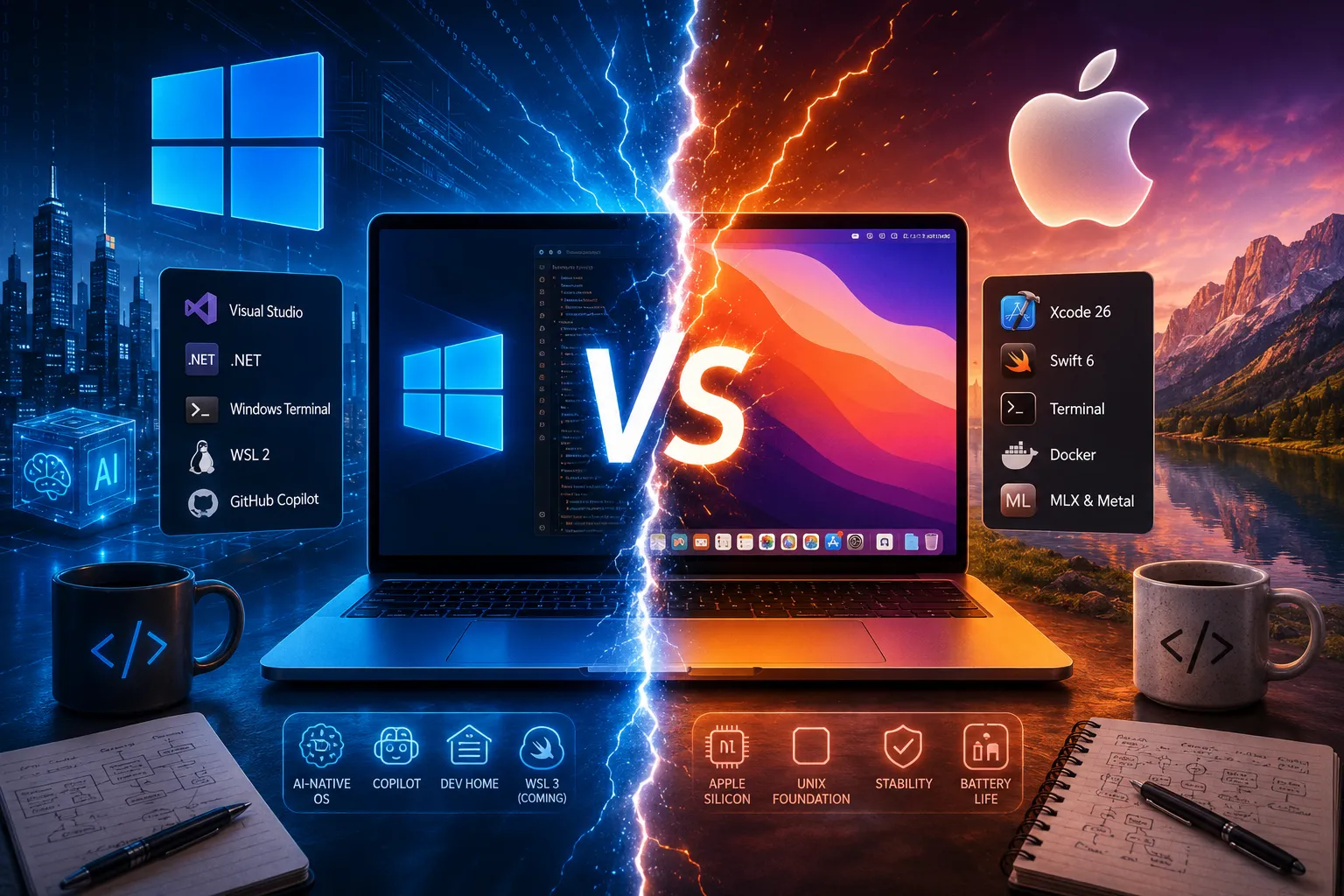
Microsoft is building Windows 12 — an AI-native operating system that has been quietly assembling itself through Windows 11 updates while Microsoft refuses to officially announce it. Apple just unveiled macOS Tahoe at WWDC 2026 — bringing a complete visual redesign, deeper Apple Intelligence integration, and developer tools that reflect how seriously Apple is chasing the professional computing market.
Two operating systems. Two fundamentally different philosophies about what a computer should be. And one question that actually matters: which one should a developer be sitting in front of every day?
I am going to answer that honestly. Not with allegiance to a logo. Not with the comfortable "it depends" non-answer. With real analysis of what each platform does well and badly for the people who write code for a living.
Let us go........
A Very Much Necessary Honesty Check...!
Before anything else I need to tell you something that most articles on this topic skip entirely because it kills the clickbait headline.
Windows 12 is not officially out yet.
As of May 2026, Microsoft has not announced Windows 12 by name. What exists is an increasingly clear picture built from leaked roadmaps, developer previews, hardware partner signals, and Microsoft's own Copilot+ PC push — all pointing toward something significant arriving in late 2026 or early 2027 under what insiders call Project Hudson Valley.
So this comparison is partly present reality and partly near-future trajectory. Where I discuss Windows 12 features I will tell you what is confirmed through leaks and developer previews versus what is still rumour. That matters because your platform decision today should be based on what actually exists — with an eye on what is genuinely coming.
macOS Tahoe is real and just announced. Apple unveiled it at WWDC 2026. It is the next version of macOS following Sequoia, bringing a major visual overhaul with Liquid Glass design language, deeper Apple Intelligence, and significant developer tooling updates.
With that established — let us compare.
Terminal and Command Line Experience
For developers the terminal is home. It is where half your working life happens. And the difference between Windows and macOS on this front is one of the most debated topics in the entire developer community.
macOS has always had the advantage here and the reason is simple: it is Unix-based. The same foundational architecture that runs Linux servers, cloud infrastructure, Docker containers, and virtually every production environment on the planet is what macOS is built on. Open a terminal on a Mac and you are in a familiar environment. Your Bash and Zsh scripts run. Your SSH commands behave the way you expect. The mental translation between your local development environment and your production server is minimal because they speak the same language.
Developers who work with web applications, cloud infrastructure, containerised environments, and Linux-based servers have been choosing MacBooks for this reason for fifteen years. It is not tribalism. It is practical friction reduction. Every hour you spend fighting environment differences between your laptop and your server is an hour not spent building.
Windows recognised this problem and built the Windows Subsystem for Linux — WSL — as its answer. WSL 2 in 2026 is genuinely impressive. It runs a real Linux kernel inside Windows, gives you full access to Linux command line tools, and integrates reasonably well with the Windows file system. For many developers who need Windows for specific reasons — .NET development, enterprise software, game development for Windows platforms — WSL 2 has been a genuine lifesaver.
But genuinely impressive and seamlessly native are different things. WSL 2 still has performance overhead when accessing Windows files from Linux. Docker on Windows through WSL 2 adds layers of complexity that simply do not exist on macOS. Real-world developers who have used both describe the Mac terminal experience as fluid and the Windows WSL experience as functional but with occasional friction that adds up over a working week.
Windows 12 is expected to bring WSL 3 with deeper integration, better file system performance, and reduced overhead. If those improvements land as described, the gap narrows significantly. But narrowing a gap is different from closing it.
Winner: macOS Tahoe — for Unix-native development workflow
Hardware Performance — Apple Silicon vs Everything Else
In 2020 Apple did something that changed the laptop industry forever. They replaced Intel processors in MacBooks with their own Apple Silicon chips — designed from scratch specifically to run macOS and developer workloads.
The M4 Pro inside the current MacBook Pro in 2026 is a genuinely different class of processor. Not marginally faster — categorically different in how it handles the specific workloads developers live in every day. Compiling large codebases. Running multiple Docker containers simultaneously. Keeping VS Code, a local database, a dev server, multiple browser tabs with DevTools open, and Slack all running without throttling. The M4 Pro handles all of this while barely warming the chassis and running for 18 to 22 hours on a single battery charge.
This matters enormously for developers in a way that gaming benchmarks simply do not capture. A developer's machine runs at 80 to 90 percent capacity for 10 to 12 hours a day. Heat management, sustained performance, and battery longevity under real sustained load are what determine whether your machine helps or hinders your work.
Windows machines with Intel Core Ultra 200-series and AMD Ryzen AI 300-series processors have closed the gap meaningfully in 2026. The best Windows laptops — the Lenovo ThinkPad X1 Carbon Gen 13, Dell XPS 15 with Core Ultra 9, ASUS ProArt Studiobook — are genuinely powerful developer machines with excellent performance.
But Apple Silicon's unified memory architecture — where CPU, GPU, and Neural Engine share the same high-bandwidth memory pool — gives MacBooks an efficiency advantage that Windows architecture has not yet replicated. Xcode builds faster on an M4 MacBook Pro than on equivalent-spec Windows machines running the same workloads.
Windows 12 is being built specifically for Copilot+ PC hardware with NPU requirements of 40+ TOPS. The new AI-native architecture will benefit from this hardware. But the full optimisation of Windows 12 for its target hardware is still months away from developers being able to evaluate properly.
Winner: macOS Tahoe — Apple Silicon performance and efficiency
Development Tools and Ecosystem
This is where Windows fights back hard and it is the round that changes the verdict for specific types of developers.
.NET and C# development: If you are building enterprise applications on Microsoft's stack, Windows is your home. Visual Studio — not VS Code, the full Visual Studio IDE — remains the most powerful .NET development environment available and its deepest features are Windows-exclusive. Azure DevOps integration, SQL Server tooling, Windows-specific APIs — the Microsoft developer ecosystem is built around Windows and using it on macOS means accepting workarounds that do not exist on the native platform.
Windows 12 Dev Home has evolved into a genuinely useful centralized developer dashboard. GitHub and Azure DevOps integration for repository management, environment configuration tools, system resource monitoring — all in one place. For developers who live in Microsoft's ecosystem this is not a small improvement.
Microsoft Copilot in Windows 12 is deeply integrated in a way that goes beyond what any macOS tool offers currently. Generating PowerShell scripts through natural language. Explaining error messages. Suggesting tools based on your workflow. Automating repetitive system tasks. For developers who use AI assistance heavily — and in 2026 that is nearly everyone — Copilot baked into the OS is a different experience from using a separate AI tool.
Game development: Unity and Unreal Engine both run on both platforms but Windows has clear advantages for game development targeting Windows platforms — which is still the majority of PC gaming. DirectX development, Windows-specific optimisation, and testing on the actual target platform all point toward Windows.
macOS Tahoe developer tools are exceptional for Apple platform development — obviously. Xcode 26 brings new Swift features, improved debugging, and tighter SwiftUI integration. If you are building iOS, macOS, iPadOS, or visionOS apps, you have no practical choice — development requires a Mac.
Cross-platform web development and data science sit more neutrally between the platforms in 2026. VS Code runs identically on both. Python, Node.js, React, TypeScript — none of these care what OS you are on. Docker performance slightly favors macOS on Apple Silicon. Python ML workloads on M4 MacBook Pro with MLX framework can be dramatically faster than equivalent Windows laptops for local model training.
Winner: Windows 12 for .NET, enterprise, and game development. macOS Tahoe for Apple platform, web, and ML development.
Stability and Reliability — The Developer's Silent Priority
Nobody writes blog posts about this. Nobody makes YouTube videos comparing OS stability. But every developer who has been working professionally for more than three years knows exactly what I am about to say.
Nothing destroys a productive coding session like an OS problem you did not cause and cannot immediately fix.
Windows has historically had a worse reputation here. Driver issues. Background processes that compete for resources at the worst times. Windows Update deciding to restart during a critical deployment. Registry problems that appear from nowhere. Compatibility issues between software versions that require hours of Stack Overflow archaeology.
Windows 11 has been more stable than Windows 10. Windows 12 with its focus on modular CorePC architecture is promising better stability through cleaner separation of system components. The direction is right.
macOS has historically been more stable for professional development work. Not perfect — anyone who has dealt with Xcode updates breaking their entire environment knows exactly how painful Apple's ecosystem can be when it decides to break. But day-to-day stability for non-Apple platform development has consistently been more reliable on macOS.
The real-world developer survey data in 2026 backs this up. The Stack Overflow Developer Survey consistently shows macOS as the preferred OS among professional developers globally — not because of brand loyalty, but because developers who have tried both platforms tend to stay on Mac for the stability and Unix foundation.
Winner: macOS Tahoe — stability and reliability for development work
AI Integration for Developers — Windows 12's Biggest Weapon...?
This is where the future conversation is genuinely interesting and where Windows 12 has the potential to shift the balance.
Apple Intelligence on macOS Tahoe is impressive for consumer use cases — writing tools, photo editing, Siri improvements. For developers specifically, the AI integration feels more like productivity assistance than a fundamental workflow change.
Windows 12's vision for AI-native development is more ambitious. Microsoft Copilot integrated directly at the OS level — not as an app overlay but as a genuine system layer — can access context across everything you are doing. It sees your open files, understands your current project, reads your error messages, and suggests fixes without you having to copy-paste anything into a separate chat window.
Recall 2.0 — the feature that semantically indexes everything you have seen or done on your PC — is controversial from a privacy standpoint. But from a pure developer productivity standpoint, being able to search "that npm error I saw last Tuesday" and have the system instantly surface the exact context is genuinely powerful. Developers who work across multiple projects and context-switch frequently will understand immediately why this matters.
AI-powered Snap Assist that learns your window management patterns. Natural language PowerShell generation. Copilot code explanation baked into the OS rather than an IDE plugin. Windows 12 is betting that AI at the OS level rather than the application level is the next evolution of developer productivity.
Whether that bet pays off depends entirely on execution. The privacy implications of Recall in particular have not been fully resolved. And features that sound compelling in keynotes have a long history of landing with more friction than promised.
But the direction is clear — and for developers who use AI assistance as a core part of their workflow in 2026, Windows 12's deeper AI integration is worth watching very closely.
Winner: Windows 12 — AI integration ambition. But macOS Tahoe wins on current execution.
Cost and Value
This one is straightforward and worth being direct about.
A MacBook Pro with M4 Pro chip, 24GB unified memory, and 512GB SSD costs approximately $2,000 in 2026. That is the starting price for the machine that most professional developers consider the right Mac for serious work.
A Windows laptop with equivalent performance specifications — Intel Core Ultra 9, 32GB DDR5, 1TB NVMe — from Lenovo, Dell, or ASUS costs $1,200 to $1,500. That is a $500 to $800 difference for comparable raw performance.
The Mac earns part of that premium back through Apple Silicon efficiency, macOS stability, and build quality that holds value longer than most Windows laptops. MacBooks have genuinely better resale value. The hardware lasts longer in a professional context.
But $800 is $800. For a student developer, a freelancer starting out, or anyone who needs to make hardware decisions based on budget reality, the Windows laptop is a legitimate professional choice at a meaningfully lower price.
Winner: Windows — entry cost and hardware value
The Honest Verdict by Developer Type
Here is what nobody else will tell you clearly.
Use macOS Tahoe if you are:
A web developer or full-stack developer whose production environment is Linux-based
An iOS, macOS, or Apple platform developer — you have no real choice
A data scientist or ML engineer doing local model work with Python
Someone who values terminal fluency and Unix-native tooling above everything
A professional who needs 18 hours of reliable battery life during travel
Someone who has been on Mac for years and values the stability dividend
Use Windows 12 if you are:
A .NET or C# developer building enterprise applications on Microsoft's stack
A game developer building for Windows platforms using DirectX
A developer who needs maximum hardware flexibility and choice
Someone who values Microsoft's AI-native OS vision and lives in Azure and GitHub
A developer whose client base requires Windows-specific testing and deployment
Someone managing a $1,200 laptop budget rather than a $2,000 one
The honest middle ground: For pure web development in 2026 both platforms are genuinely capable. VS Code runs identically on both. The frameworks do not care. Docker works on both. If you are purely building web applications without a strong opinion about your server environment, your personal preference matters more than any objective technical argument.
BS Insider's Scorecard
Category | Windows 12 | macOS Tahoe |
|---|---|---|
Terminal & Unix Tools | 7/10 — WSL 2 is good, not native | 9.5/10 — Native Unix foundation |
Hardware Performance | 8/10 — Strong but not M4-efficient | 9.5/10 — Apple Silicon unmatched |
Developer Ecosystem | 9/10 — .NET, enterprise, gaming | 8.5/10 — Apple platforms, web, ML |
Stability & Reliability | 7.5/10 — Improving but historically weaker | 9/10 — Consistent for dev work |
AI Integration | 9/10 — Most ambitious OS-level AI | 7.5/10 — Good but less dev-focused |
Cost and Value | 9/10 — Better hardware value | 7/10 — Premium pricing |
OVERALL | 8.3/10 | 8.5/10 |
The Final Word
macOS Tahoe wins this comparison narrowly in 2026. The Unix foundation, Apple Silicon performance, and development stability give it a consistent edge for the majority of developers who are not locked into Microsoft's specific ecosystem.
But Windows 12 is the most interesting Windows has been for developers in a decade. The AI-native vision is real. The developer tooling investment is genuine. And if Microsoft executes on the full Windows 12 promise — particularly the deeper Copilot integration and WSL 3 improvements — the gap between these platforms for general development work will be smaller in 2027 than it is today.
Here is the truth that all the platform wars miss entirely.
The best OS for a developer is the one that removes friction between your brain and your code. For most developers in 2026 that is still macOS. For .NET enterprise developers and game developers that is Windows. For the developer who is just starting out and working with a real budget, a good Windows machine with WSL 2 will get you further than the stress of stretching toward a $2,000 MacBook before you need it.
The platform does not write the code. You do.
Pick the tool that gets out of your way fastest.
Bilal Salfi | BS Insider