The Great Hollywood Reality Check: Why the $1 Billion "Sora" Collapse Changed Everything in 2026
For the last three years, the narrative in Tinseltown was simple: AI is coming for the director's chair, the writer's room, and the actor’s face. We were told that by 2026, we’d be watching Marvel movies generated in real-time by a prompt. But as we sit here in May 2026, the reality is far more complicated, and arguably more interesting.
We just witnessed the single biggest "rug-pull" in tech history: the sudden shutdown of OpenAI’s Sora video platform and the subsequent collapse of the $1 billion Disney partnership.
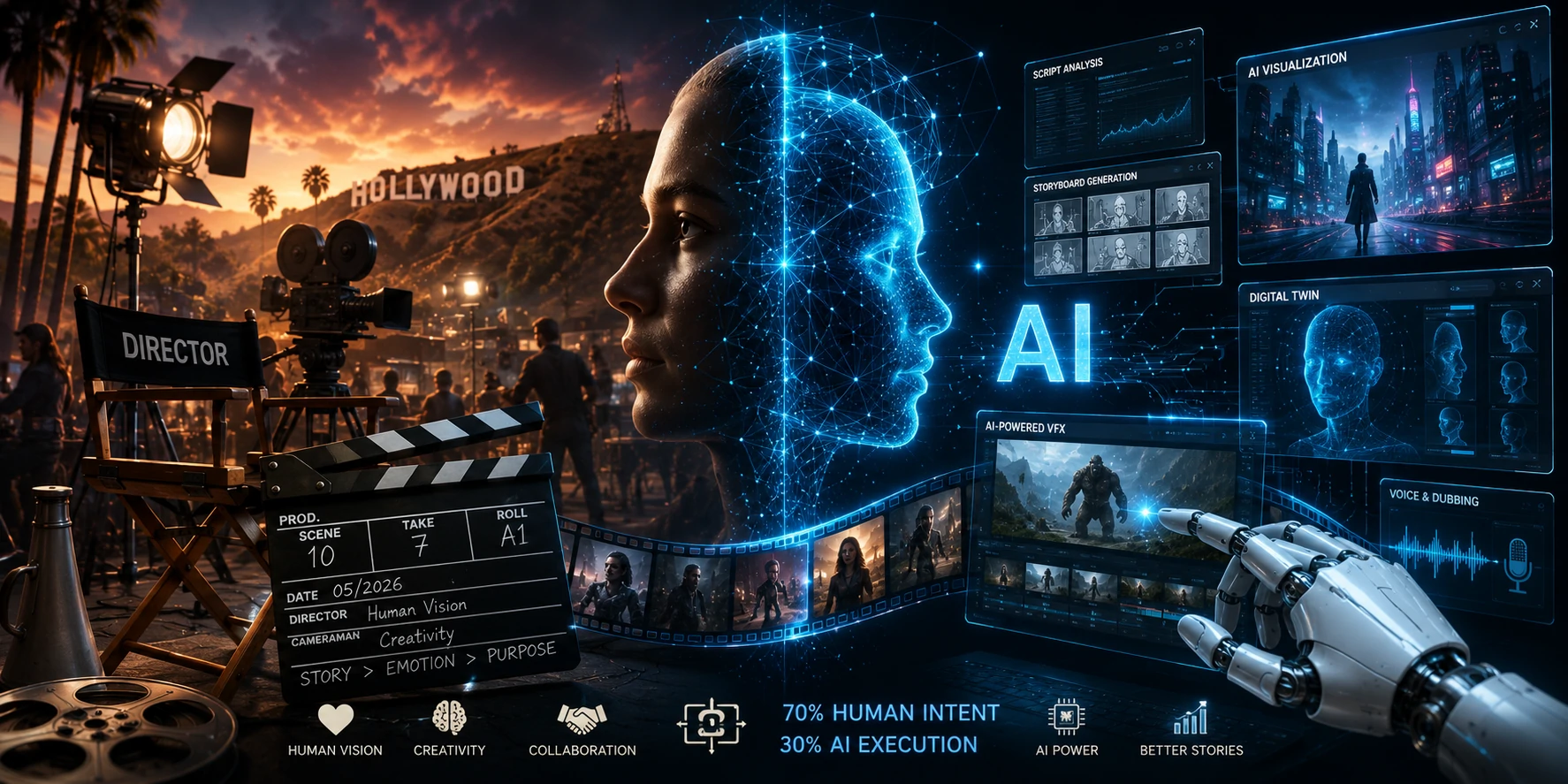
At BS Insider, we’ve always said that technology is a tool, not a replacement for the soul. The 2026 Hollywood landscape is the ultimate proof of our 70/30 usage Rule. AI is finally finding its place, but it’s not as the "Chief Creative Officer." It’s as the world’s most overworked, highly efficient intern.
The Sora Fallout: Why the "Billion-Dollar Dream" Died
In late 2025, the industry was buzzing. OpenAI and Disney had announced a landmark deal to bring licensed characters like Mickey, Yoda, Iron Man into a controlled generative environment. The idea was that creators could make "safe" fan content using the Sora engine.
Then came March 2026. OpenAI pulled the plug.
The Computing Wall
Why did it fail? It wasn't just the lawsuits (though those were a headache). It was the physics of compute. Generating high-fidelity, physically accurate video at a Hollywood standard requires an astronomical amount of energy and GPU power. As OpenAI pivoted toward its IPO and more "profitable" sectors like enterprise coding and agentic AI, Sora became a luxury they couldn't afford to scale.
This collapse sent a shockwave through the studios. It proved that while AI can make a stunning 5-second clip of a "neon cat," it still struggles to maintain the narrative consistency required for a 90-minute feature film without human "hand-holding" every step of the way.
The Rise of the "Digital Twin" and the New Rules of Consent
While the video generators stumbled, the "Digital Replica" industry exploded. Thanks to the 2025 SAG-AFTRA Interactive Media Agreement, we now have a clear legal framework for how an actor's likeness is used.
Beyond the Deepfake
We are no longer in the "scary deepfake" era. We are in the era of Authenticated Digital Assets. Actors like Tom Hanks and younger stars are now "cloning" their voices and faces through companies like Metaphysic.ai.
The Benefit: A star can "shoot" three movies at once. They do the emotional performance capture in a studio for a week and the AI handles the "busy work" of localized dubbing and physical stunts.
The Catch: "Informed Consent" is now the gold standard. A studio cannot just "tweak" a performance. Every line of AI-generated dialogue (calculated in "10-word units" for payment) must be approved by the human performer.
The Script Sense Problem: Are We Making "Too Safe" Movies?
The real AI revolution in Hollywood isn't happening on the screen; it’s happening in the Development Office.
Tools like Script Sense are now standard at major agencies like WME. These AI agents read thousands of scripts in seconds, generating "coverage" (summaries) and predicting box-office success based on historical data.
The Homogenization Risk
This is where the 70/30 Rule is being violated. If you let an AI decide which scripts get greenlit (the 70%), you end up with movies that are mathematically "safe" but emotionally hollow. AI favors familiar plot beats. It likes "The Hero’s Journey" because that’s what it was trained on.
The danger for 2026 isn't that AI will write a bad movie; it’s that AI will stop us from making "strange" movies. The next Everything Everywhere All At Once might be flagged by an AI as "too risky" because it doesn't fit the established data patterns. At BS Insider, we believe the human must remain the 70%, the one who says, "I know the data says this won't work, but it's brilliant anyway."
The $200 Movie: The Democratization of the Indie Scene
While the big studios are fighting over billion-dollar deals, the "garage filmmakers" are winning.
In 2026, you can produce a 3-minute, high-quality narrative short film for roughly $150 to $200.
Scripting: Iterating with Claude 3.7 or Gemini Ultra for $0.10 in tokens.
Visuals: Using Kling AI 2.0 or Luma Ray3 for consistent character generation.
Voice: ElevenLabs for hyper-realistic narration.
Music: Udio or Suno V4 for a full cinematic score.
This is the "Prosumer" revolution. A kid in Islamabad or Rawalpindi now has the same "VFX department" power that James Cameron had ten years ago. This doesn't replace Hollywood, but it creates a Parallel Industry where talent matters more than a $50 million budget.
The Workforce Shift: From "Grips" to "Prompt Engineers"?
The most painful part of this deep dive is the impact on "below-the-line" workers. Set builders, lighting technicians, and background extras are seeing their roles shrink as "Virtual Production" (The Volume) and AI-generated backgrounds become the norm.
However, new roles are emerging. We’re seeing the rise of the "AI Compositor"—someone who doesn't just "generate" an image, but meticulously cleans and stitches AI outputs into a human-directed scene. This is a technical, MIT-level skill set (one that we appreciate here at BS Insider). It requires a deep understanding of lighting, focal length, and "The Uncanny Valley."
The 70/30 Verdict: Why the Heart Still Beats in Analog
As we look toward 2027, the "AI vs. Hollywood" war has reached a stalemate.
The studios tried to automate creativity and failed (the Sora/Disney collapse). The creatives tried to ban AI and realized they couldn't compete without its efficiency.
The result? A hybrid future.
The most successful films of 2026 are those where:
70% Human Intent: The vision, the emotional core, and the "weird" ideas come from a human director who knows how to break the rules.
30% AI Execution: The rotoscoping, the color grading, the "de-aging," and the background renders are handled by specialized models to keep the budget under control.
AI is the most powerful "Research Assistant" Hollywood has ever had. It can help you storyboard in seconds, it can find the perfect "digital double" for a stunt, and it can help translate your movie into 50 languages. But it cannot tell you why a story matters.
The BSinsider.site Takeaway
We shouldn't fear the machine; we should fear the "safe" story. If you’re a creator, use these tools to lower your costs, but keep your hands on the steering wheel. Don't let the AI be your "Chief Creative Officer."
The best movies of the next decade won't be "made by AI." They will be "Human-directed, AI-accelerated." And honestly? That’s a future worth buying a ticket for.
What’s your take? Would you watch a movie if you knew the script was vetted by an AI "Success Predictor"? Or are you sticking to the indie films made for $200? Let me know in the comments.