The Death of the Smartwatch: Why the $100 Fitbit Air is Google’s Most Important Move in 2026
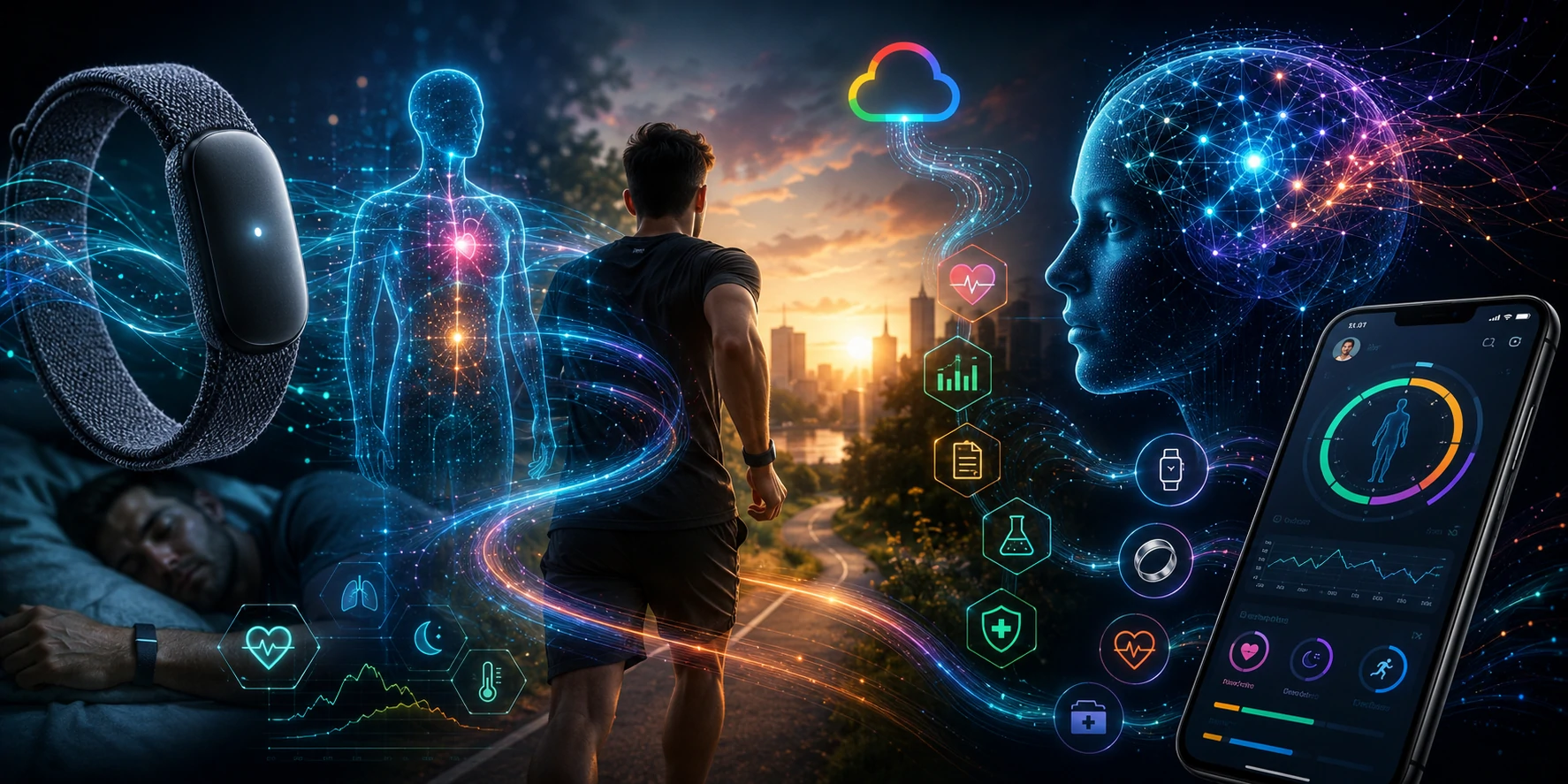
This isn’t just another "new gadget" announcement. We are witnessing a fundamental shift in how we inhabit our own bodies. For over a decade, wearables have been glorified pedometers that occasionally buzzed when your boss emailed you. But with the rollout of the Fitbit Air and the Google Health AI Coach, the paradigm has shifted from tracking to interpretation.
At BS Insider, we’ve always advocated for the 70/30 Rule: 70% human intent, 30% AI execution. This new ecosystem is the ultimate test of that philosophy. Are we gaining a personal health assistant, or are we outsourcing our intuition to a Large Language Model?
Let’s pull back the curtain on the silicon and the science.
The Death of the Notification Machine
The most striking thing about the Fitbit Air isn't what it has, but what it lacks. There is no screen. No buttons. No "Find my Phone" feature.
Google is making a massive bet: Screen fatigue is real. By stripping the device down to a 12-gram fabric band, they are pivoting toward "Invisible Tech." This isn't a smartwatch; it’s a high-fidelity biological sensor meant to be forgotten on your wrist.
Why Screenless Matters
When you remove the screen, you remove the distraction. You also solve the two biggest pain points in wearables:
Battery Life: Without a display to power, the Air pushes into the 10-14 day territory, even with high-frequency sampling of HRV (Heart Rate Variability) and skin temperature.
Psychological Friction: A screen invites you to check your stats every ten minutes, which paradoxically increases stress. The Air forces you to engage with your health data through the app, turning health management into a deliberate, focused activity rather than a series of micro-interruptions.
The Brain: PH-LLM (The First "Doctorate" for Gemini)
Under the hood of the rebranded Google Health app is PH-LLM (Personal Health Large Language Model). This isn't just a chatbot that knows a few fitness facts; it’s a specialized version of Gemini Ultra 1.0 fine-tuned on millions of anonymized clinical data points.
The Soft Token Revolution
Standard AI models struggle with numbers. If you tell an AI your heart rate is 72 bpm, it treats "72" as a text character. PH-LLM uses MLP-based (Multi-Layer Perceptron) adapters to bridge the gap.
Think of it as a translator: These adapters take raw numerical sensor data—the spikes in your sweat levels, the micro-fluctuations in your pulse—and convert them into "soft tokens." These tokens allow the AI to "feel" the data in its embedding space. It doesn't just see a "drop in HRV"; it understands the physiological signature of a body fighting an oncoming flu or a body that didn't recover from yesterday’s workout.
BS Insider Technical Insight: This architecture allows for "cross-modal reasoning." It can look at your calendar (via Google Workspace), see you had a late-night flight, and correlate that with your poor sleep scores to give you a recovery plan that actually makes sense for your schedule.
The Integration: Your Clinical Record is Now an API
The real "Holy Grail" here isn't the heart rate sensor; it’s the Electronic Health Record (EHR) integration.
In the 2026 Google Health ecosystem, you aren't just looking at steps. You can pull in your lab results, cholesterol levels, and prescription history. This creates a closed-loop system that we’ve never seen in consumer tech:
The Problem: Most wearables tell you to "move more."
The Google Solution: "Since your lab results show elevated LDL and you’re on a specific medication, today’s 20-minute zone 2 cardio is more beneficial for your vascular health than a high-intensity sprint."
This moves us from "Generic Wellness" to "Precision Medicine." By using Health Connect, Google is effectively building a "Universal Health OS" that can ingest data from an Oura ring, a Garmin bike computer, and a hospital’s patient portal simultaneously.
The 2026 Migration: The End of the Fitbit Era
We need to talk about the "elephant in the room": May 19, 2026. This is the hard deadline for the forced migration of Fitbit accounts to Google accounts.
For the "old guard" of Fitbit users, this feels like a loss of identity. But from a systems administration perspective, it’s a necessary consolidation. To run an LLM as powerful as PH-LLM, Google needs a unified data infrastructure. You can't provide "Expert AI Coaching" if half your data is sitting on a legacy Fitbit server architecture that doesn't talk to the Gemini API.
The Subscription Gamble
Google is charging $10/month for the full AI coaching suite. This marks the transition of wearables from a "Hardware Sales" business to a "Software-as-a-Service" (SaaS) model. You aren't paying for the $100 fabric band; you’re paying for the compute power required to have a supercomputer analyze your biology 24/7.
Google is clearly undercutting Whoop on hardware price while aiming to outperform Apple on clinical depth. By making the AI Coach available to Apple Watch users (via the Google Health app), Google is trying to win the Software War, even if they lose the Hardware War.
The May 2026 Migration: The End of the Fitbit Era
We need to talk about the "elephant in the room": May 19, 2026. This is the hard deadline for the forced migration of Fitbit accounts to Google accounts.
For the "old guard" of Fitbit users, this feels like a loss of identity. But from a systems administration perspective, it’s a necessary consolidation. To run an LLM as powerful as PH-LLM, Google needs a unified data infrastructure. You can't provide "Expert AI Coaching" if half your data is sitting on a legacy Fitbit server architecture that doesn't talk to the Gemini API.
Google is also charging $10/month for the full AI coaching suite. This marks the transition of wearables from a "Hardware Sales" business to a "Software-as-a-Service" (SaaS) model. You aren't paying for the $100 fabric band; you’re paying for the compute power required to have a supercomputer analyze your biology 24/7.
Privacy, Which is High-Stakes Trade-off
Let's address the concern everyone has: Is Google selling my heart rate to insurance companies?
Under the 2021 acquisition terms and the updated 2026 privacy protocols, health data is legally siloed. It cannot be used for the Google Ads engine. However, the "Product" is now your attention within the Google Health ecosystem. While your data might not be sold, your behavior is being nudged.
The AI Coach is a "Human-on-the-Loop" system. It suggests, but it doesn't command. However, as these models become more persuasive, we have to ask: Who is actually in charge of your health? You, or the model trained on the "average" human?
The BS Insider Verdict
The Fitbit Air and PH-LLM represent the first time AI isn't just a gimmick in our pockets, it’s a layer of our biology.
As a tech community, we should welcome the clinical depth and the invisible hardware. It aligns perfectly with the idea that technology should serve us, not distract us. But we must remain the 70% in the 70/30 equation. Use the AI to analyze the patterns you’re too busy to see, but never let a "Soft Token" override how you actually feel when you wake up in the morning.
The future of health isn't about more data. It's about better synthesis. Google just set the bar incredibly high.
What do you think...?
Are you ready to trade your screen for a fabric band and an AI doctor? Or is this "Invisible Tech" a step too far into our private lives? Let’s talk in the comments below.