Samsung Galaxy S26 vs iPhone 17: The Flagship Fight That Actually Matters in 2026
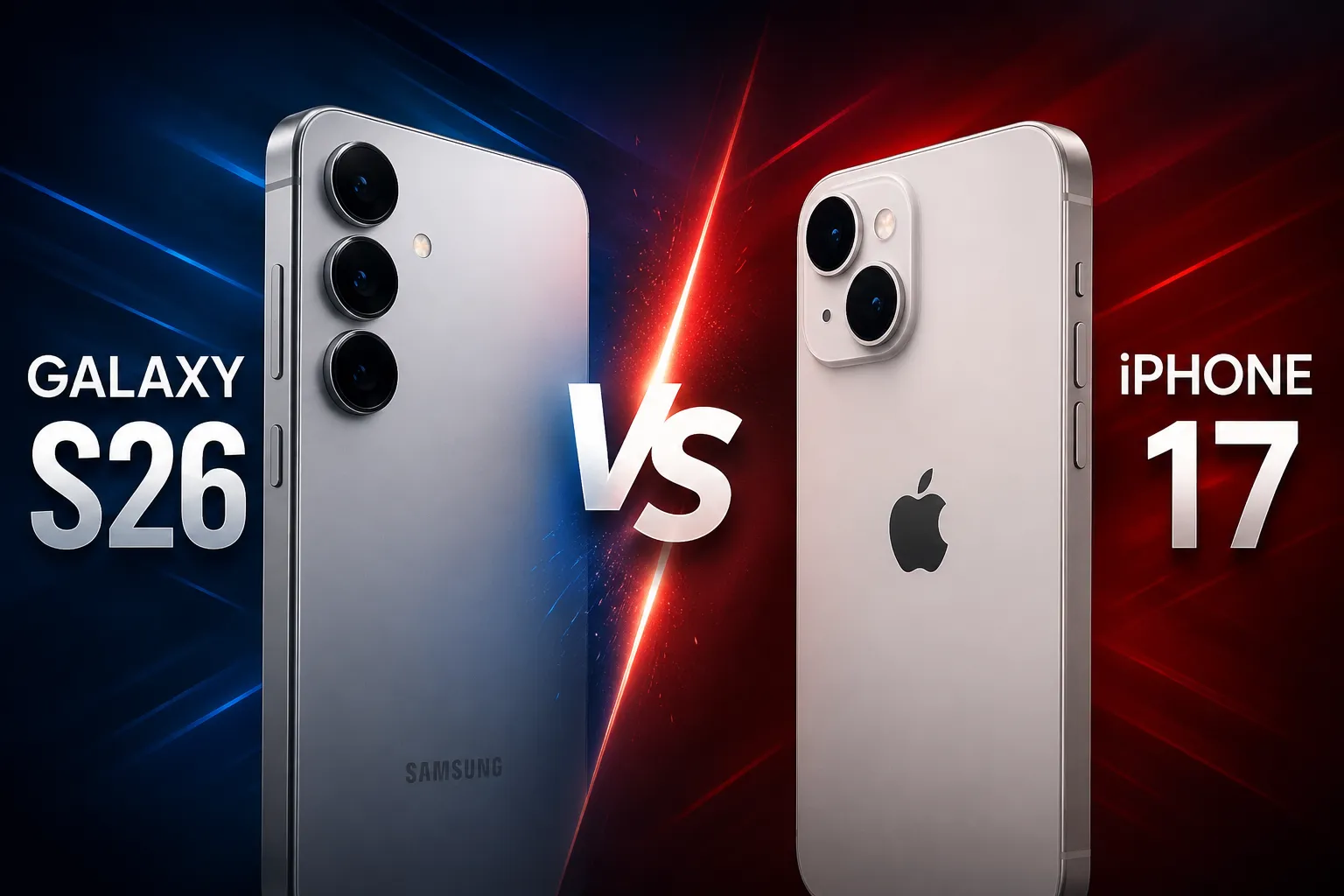
Two giants. Two philosophies. One winner - and the answer might surprise you.....!
The Question Every Smartphone Buyer Is Asking Right Now
It is May 2026. You walk into a phone store — or open a browser — and you are staring at two phones. One has that familiar Samsung logo. The other has the Apple bitten apple. Both cost somewhere around $800. Both promise to be the best. Both have armies of fans online ready to fight for them.
But here is the real question nobody answers honestly: which one actually wins for a normal human being who just wants the best phone for their money?
I spent weeks looking at both. I read every review. I studied every spec. I compared real-world usage. And I am going to give you the most honest, detailed, and human answer you will find anywhere on the internet.
Let's go....
The Actual Numbers Side by Side
Before opinions, let us look at raw facts. Here is the full spec comparison:
Feature | Samsung Galaxy S26 | Apple iPhone 17 |
|---|---|---|
Display | 6.3-inch AMOLED, 120Hz, 2600 nits | 6.3-inch Super Retina XDR OLED, 120Hz, 3000 nits |
Processor | Snapdragon 8 Elite Gen 5 (US) / Exynos 2600 (Global) | Apple A19 chip |
RAM | 12GB | 8GB |
Storage | 256GB / 512GB | 256GB / 512GB |
Main Camera | 50MP f/1.8, same hardware 4 years in a row | 48MP f/1.6 Fusion, dual-lens system |
Ultrawide | 12MP ultrawide | 48MP Fusion ultrawide |
Battery | 4300 mAh | 3692 mAh |
Charging | 25W wired (slowest flagship of 2026) | Fast charge via USB-C, MagSafe wireless |
OS | Android 16, One UI 8.5, 7 years updates | iOS 26, Apple Intelligence, 5-6 years updates |
Weight | 167g (lightest flagship available) | 177g |
Thickness | 7.2mm (incredibly slim) | 8mm |
Price | Starting ~$799-$849 | Starting $799 |
IP Rating | IP68 | IP68 |
5G | Yes, Snapdragon X80 modem | Yes, Qualcomm Snapdragon X80 modem |
Extras | Now Nudge AI, Bixby, No MagSafe | Camera Control button, Action button, MagSafe |
Round 1: Design and Build, Which Feels Better in Your Hand...?
This is where Samsung pulls off something genuinely impressive in 2026. The Galaxy S26 is one of the few compact flagship phones that actually feels compact. At 167 grams and just 7.2mm thin, it is nearly 20 percent lighter and slimmer than the iPhone 17. That is not a small difference. That is the difference between forgetting your phone is in your pocket and constantly being aware of it.
The iPhone 17 at 177 grams and 8mm is not heavy by any stretch. But hold both phones for 10 minutes and you will feel the difference. Samsung went all-in on making this phone disappear in your hand. And it succeeded.
However, Apple wins on two things Samsung simply does not offer: the Camera Control button and the Action Button. These are two physical buttons that let you instantly jump to the camera, launch shortcuts, or customise any function you want. Once you use them, going back to a phone without them feels like a step backward. Samsung only gives you power and volume. That is it.
The satin finish on the S26 hides fingerprints beautifully. The Ceramic Shield 2 on the iPhone 17 offers 3x better scratch resistance than the previous generation. Both look stunning. Both feel premium. But Samsung has the edge on pure physical comfort.
Winner: Samsung Galaxy S26 — Design
Lighter, thinner, and more comfortable to hold for long periods. But iPhone wins on physical button variety.
Round 2: Display, Which Screen Actually Looks Better...?
Both phones have 6.3-inch displays. Both have 120Hz refresh rates. Both look stunning on paper. But the details matter.
The iPhone 17 peaks at 3000 nits brightness versus the S26's 2600 nits. In direct sunlight, that 400-nit difference is real and visible. Apple's display is simply brighter outdoors, and in countries like Pakistan where sunlight is intense, that matters.
Samsung counters with its ProScaler technology, which upscales lower-resolution content to look sharper on the screen — a clever software trick that genuinely works. The Android Ultra HDR support also means compatible photos look noticeably more vivid.
There is one frustrating limitation on the S26: it is Full HD+ only, with no option to scale resolution up like on the S26 Plus or Ultra. The iPhone 17's Super Retina XDR display is sharper per pixel. And the iPhone also has 33 percent fewer reflections, which is a detail that matters enormously when you use your phone in different lighting conditions.
It is close. Very close. But Apple edges it.
Winner: Apple iPhone 17 — Display
Brighter outdoors at 3000 nits, fewer reflections, and sharper Super Retina XDR technology. Samsung's ProScaler is good but not enough to close the gap.
Round 3: Performance, Raw Power Comparison
Here is where things get interesting. On paper, Samsung looks dominant. 12GB of RAM versus Apple's 8GB. Snapdragon 8 Elite Gen 5. It sounds like a blowout.
But real-world performance tells a different story.
Apple's A19 chip is a masterclass in efficiency. With 8GB of RAM running iOS 26, the iPhone 17 handles everything from heavy gaming to 4K video editing without breaking a sweat. Apple's software and hardware work together so tightly that 8GB on an iPhone feels like 16GB on Android.
Samsung's Snapdragon 8 Elite Gen 5 is genuinely powerful and stays cool under normal gaming loads. Global Exynos 2600 variants also perform well. But One UI 8.5, while feature-rich, adds more background processes and RAM overhead than iOS 26. The S26 is fast. The iPhone 17 is efficient. Different kinds of speed.
For pure benchmark numbers, they trade blows depending on the test. For day-to-day smoothness and long-term consistency, iOS edges ahead slightly — especially after 12 to 18 months of use, when Android phones tend to slow down more noticeably than iPhones.
Samsung promises 7 years of OS updates vs Apple's typical 5-6. For long-term value, Samsung actually wins here on paper.
Winner: Apple iPhone 17 — Performance
Fewer gigabytes, but Apple's chip efficiency and software optimization deliver smoother real-world performance. Samsung wins on raw specs and update longevity.
Round 4: Camera, The Thing Everyone Cares About Most
Let me be honest about Samsung first, because I have to be.
The Galaxy S26's camera hardware has not changed in four years. Same 50MP main sensor with f/1.8 aperture. Same 12MP ultrawide. Same 10MP 3x telephoto. Samsung improved processing behind the scenes, but the actual glass and sensor you are shooting through is identical to the S23. In 2026, that is hard to defend.
Apple, on the other hand, upgraded the iPhone 17 to a dual-lens system where both lenses are 48 megapixels — the main at 48MP f/1.6 and the ultrawide also at 48MP. That f/1.6 aperture on the main camera is wider than Samsung's f/1.8, meaning more light enters the sensor in every shot. More light means better photos, especially at night.
The iPhone 17 also includes Camera Control — a physical button on the side that makes launching the camera and adjusting settings feel instant and intuitive. It sounds like a small thing until you use it every day.
Real-world results show the iPhone 17 producing more natural, true-to-life colours, while Samsung tends to oversaturate and over-sharpen — which looks impressive at first glance but loses accuracy. For social media posting, Samsung's punchy colours might be preferred. For accurate photography, iPhone wins.
For video, iPhone 17 supports 4K Dolby Vision, which is a significant step up. Samsung also does excellent video but lacks the same codec-level professional support.
If you are a content creator or someone who cares deeply about photo quality, the iPhone 17's camera upgrade cycle means you are getting genuinely new hardware. Samsung is running on a four-year-old sensor.
Winner: Apple iPhone 17 — Camera
Wider aperture, dual 48MP system, better low-light performance, Camera Control hardware button, and 4K Dolby Vision video. Samsung's camera is still good but running on aging hardware.
Round 5: Battery Life, The One Area Samsung Always Dominates
Samsung has a 4300 mAh battery. iPhone 17 has 3692 mAh. That is a 600 mAh gap and it shows in real-world usage. Heavy users consistently report the S26 lasting longer through a full day than the iPhone 17.
But here is the painful caveat for Samsung: the charging speed is 25W wired. In 2026. When competitors are shipping 65W, 100W, even 120W charging in flagship phones. Reviewers across the board have called the Galaxy S26 the slowest charging flagship phone of 2026. A bigger battery that takes forever to refill is a frustrating combination.
The iPhone 17 charges faster relatively, and MagSafe wireless charging is a genuine quality-of-life feature that Samsung still refuses to include. You can use magnetic cases with the S26 but the phone itself has no built-in magnets.
For raw battery life away from a charger: Samsung wins. For the overall charging ecosystem and wireless convenience: iPhone wins.
Winner: Samsung Galaxy S26 — Battery Life
4300 mAh vs 3692 mAh means more hours per charge. But the 25W charging speed is embarrassingly slow for a 2026 flagship. Apple wins on charging ecosystem.
Round 6: Software and AI, The Ultimate Feature War
Both phones are betting big on AI in 2026 and both have interesting takes on what that means.
Samsung's One UI 8.5 is the most feature-packed Android skin available. The new Now Nudge feature monitors your screen context and proactively suggests actions — if a friend texts you a location, a nudge appears that takes you directly to Maps. Now Brief gives you personalized daily summaries. Bixby has improved with natural language understanding for device settings.
Apple Intelligence on iOS 26 takes a different approach: privacy-first AI that runs as much as possible on-device. Writing Tools, Visual Intelligence, and Clean Up in photos are seamlessly integrated. The experience feels more polished and less experimental than Samsung's AI features.
One UI has more features. iOS is more refined. It is the classic Samsung vs Apple software debate played out again at a higher level in 2026.
For customization lovers: Samsung in a landslide. For people who want things to just work beautifully: iPhone wins.
My Verdict: Which Phone Should You Actually Buy?
Here is the honest, uncomfortable truth about this comparison: there is no single winner. But there is definitely a winner for YOU, depending on who you are.
Buy the Samsung Galaxy S26 if:
You want the lightest, thinnest compact flagship available
Battery life is your number one priority
You love Android customization and feature-rich software
You are upgrading from an older Samsung or Android device
You want 7 years of software updates
You play mobile games heavily and want maximum RAM
Buy the Apple iPhone 17 if:
Camera quality is your number one priority
You want the best display for outdoor brightness
You are already in the Apple ecosystem (MacBook, iPad, AirPods)
You prefer a polished, consistent software experience
The Camera Control and Action button features excite you
MagSafe wireless charging matters to your daily routine
If you are buying your first flagship or switching from an old phone: the iPhone 17 is the safer, more future-proof choice. If you are a power Android user who wants maximum control and longest battery: the Galaxy S26 is your phone.
BS Insider Final Scorecard
Category | Samsung Galaxy S26 | Apple iPhone 17 |
|---|---|---|
Design & Build | 9/10 — Lighter and thinner than anything | 8/10 — Heavier but Camera + Action buttons |
Display | 8/10 — ProScaler is clever, but FHD+ only | 9/10 — Brighter, sharper, fewer reflections |
Performance | 8.5/10 — Powerful chip, feature-rich OS | 9/10 — Unmatched chip efficiency |
Camera | 7.5/10 — 4-year-old hardware, great processing | 9/10 — Dual 48MP upgrade, better aperture |
Battery Life | 9/10 — 4300 mAh easily lasts all day | 7.5/10 — Smaller battery, but MagSafe wins |
Software & AI | 8.5/10 — Most features, most customisable | 8.5/10 — Most refined, most private |
Value | 8/10 — Strong value if on Android | 8.5/10 — Best in Apple ecosystem |
OVERALL | 8.4/10 | 8.7/10 |
Final Words from BS Insider
Both phones are genuinely excellent. Neither is a bad choice. But in 2026, the iPhone 17 wins by a narrow but clear margin — driven primarily by the camera upgrade, display brightness, and the overall refinement of Apple Intelligence on iOS 26.
Samsung's response to losing this round should be better charging speeds and a camera hardware upgrade. Four years on the same sensor is too long for a flagship that costs $800.
That said — if you are an Android person and always have been, the Galaxy S26 will not disappoint you. It is light, fast, long-lasting, and backed by seven years of updates. That is a serious commitment Samsung is making to you.
Choose based on your life. Not based on hype.
Bilal Salfi | BS Insider