Is YouTube Dying? The 2026 Creator Crisis Nobody Wants to Talk About Honestly
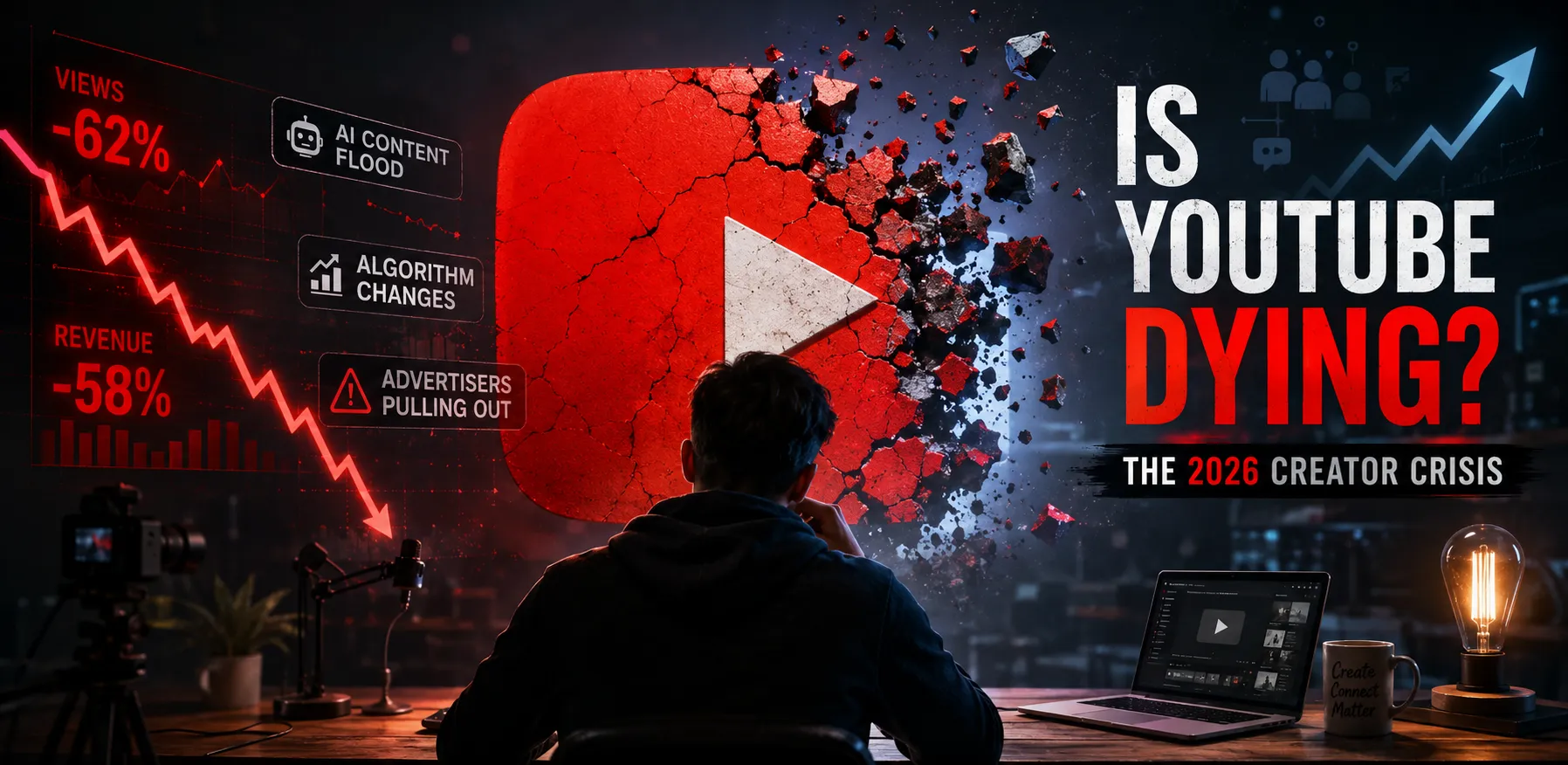
Something Changed. Creators Felt It First.
In January 2026 something quietly broke on YouTube.
Creators who had been building channels for years — some with millions of subscribers, some with decades of uploaded content — started posting screenshots on X and Reddit. Views had collapsed overnight. Revenue had dropped 40, 50, sometimes 70 percent with no explanation. No strikes. No warnings. No policy violation notices. Just numbers falling off a cliff.
YouTube's public response was silence.
Then sixteen major channels disappeared from the YouTube Partner Program in a single sweep. These were not small hobby accounts. Combined they held 4.7 billion views and earned $10 million in yearly revenue. Gone. Quietly removed with a policy update that most people did not read until after the damage was done.
The creator community exploded. Forums filled with anger. YouTube said it was cracking down on AI-generated content. Creators who had never used AI in their lives watched their analytics crater anyway.
So is YouTube dying?
The honest answer is complicated. And it deserves better than a panic headline.
What Is Actually Happening — The Real Picture
YouTube is not dying. Let us be clear about that first.
YouTube has over 2.7 billion logged-in monthly users in 2026. More video content is uploaded every day than any human being could watch in several lifetimes. Google's advertising revenue from YouTube remains in the tens of billions annually. The platform is not going anywhere.
But something real has shifted. And understanding what has shifted is more useful than either the panic narrative or the "everything is fine" dismissal.
Three forces collided in 2026 and created the crisis creators are feeling right now.
AI Flooded the Platform and Ruined It for Everyone
The first and most significant force is one that nobody caused intentionally but everyone is paying for.
AI-generated video content exploded in 2025 and 2026. Channels producing thousands of videos with zero human input — automated scripts, AI voiceovers, stock footage stitched together by algorithms — flooded YouTube with monetizable content at a scale no human creator could match. These channels cost essentially nothing to run and generated advertising revenue around the clock.
The problem is not just that these channels existed. The problem is what they did to the advertising economy.
Advertiser budgets on YouTube are not unlimited. When the supply of monetizable videos triples because AI channels are churning out content at industrial scale, the same advertiser money gets divided across far more videos. The revenue per thousand views — the RPM that creators actually earn — drops for everyone. Human creators working hard to produce genuine content found their income falling not because their content got worse but because the platform got more crowded with content that cost nothing to make.
YouTube's January 2026 crackdown was a direct response to this. The platform started enforcing what it calls the "reused content" policy strictly — removing channels that produce mass-generated videos without substantial human creative input from the Partner Programme entirely. Sixteen major channels went down in the first sweep. More followed.
The policy is correct. The execution was messy. The algorithm flagged first and humans reviewed later — meaning by the time a wrongly flagged video got cleared, its peak viewing window had already passed. Income lost during that window was gone forever. Creators who had never touched AI tools found themselves caught in detection sweeps designed for channels producing a thousand videos a week.
The anger is understandable. The direction of the policy is still right.
The Algorithm Quietly Changed What It Rewards
Here is the part that hit creators who had nothing to do with AI content.
YouTube's algorithm in 2026 changed what it optimises for. The platform shifted away from rewarding raw view counts toward something it calls watch quality — retention speed, engagement depth, and audience satisfaction scores. Videos that hold viewers for the first 30 seconds get pushed. Videos where viewers drop off early get buried, regardless of how many total views they eventually accumulate.
The practical result for creators was brutal. Channels that had built audiences over years — with loyal viewers who watched long, thoughtful videos completely — found their content being deprioritised against shorter, algorithmically optimised videos with faster hooks and higher early retention percentages.
Human creators, the research showed, simply cannot consistently produce videos that match the early retention metrics of AI-edited content engineered specifically to beat the algorithm. The irony is sharp: YouTube cracked down on AI content while simultaneously building an algorithm that rewards the characteristics AI content is best at producing.
This is the contradiction at the heart of the 2026 creator crisis. YouTube wants authentic human content. But its algorithm increasingly rewards the mechanical perfection that human creativity cannot always deliver.
Advertisers Got Nervous and Pulled Money
The third force is the quietest one but financially it may be the most damaging.
YouTube's brand safety problem got worse in 2025 and 2026. AI deepfakes appearing on the platform. Synthetic controversies manufactured by bot networks. Political content that made major advertisers deeply uncomfortable about where their logos were appearing. Several significant advertising campaigns pulled from YouTube entirely citing brand safety concerns.
When advertisers leave, creators suffer directly. Lower advertiser demand means lower CPM rates across the board. A technology creator in Pakistan or India — markets that already receive lower CPM rates than US or European creators — felt this double impact. Global advertiser nervousness on top of already lower geographic rates made the income mathematics increasingly difficult.
YouTube responded by actually relaxing some of its monetisation guidelines in January 2026 — allowing more content on controversial topics to earn full ad revenue if handled non-graphically. The move was designed to bring advertisers back by demonstrating the platform could host mature content without being unsafe. Whether it works is still playing out.
So What Does YouTube Actually Look Like for Creators Right Now?
It is harder than it was three years ago. That is the honest truth.
The golden era of YouTube — 2018 to 2022, when a consistent creator in almost any niche could build a sustainable income with moderate subscriber numbers — is genuinely over. The platform has matured in ways that reward established channels and make the path harder for newer creators.
But sustainable income is still absolutely possible. Creators who understand what the platform actually rewards in 2026 are still building real audiences and real revenue.
What works now is different from what worked before.
Long-form content with genuine depth still gets rewarded — but the hook matters more than ever. The first 30 seconds of any video are now more important than the entire rest of it. Not because depth does not matter but because you have to earn the right to deliver depth by holding attention first.
Niche authority beats broad entertainment. YouTube's algorithm in 2026 favours creators who own a specific topic deeply over creators who cover everything broadly. A channel that is genuinely the best source for a specific subject will outperform a channel that chases trending topics without expertise.
Community depth beats subscriber count. Creators with 100,000 deeply engaged subscribers who click, watch fully, and comment actively earn more and grow faster than creators with 500,000 passive followers who scroll past. YouTube's new metrics reward the relationship, not just the reach.
Diversified income matters more than ever. Creators who rely entirely on AdSense revenue in 2026 are the most vulnerable. The platform is actively building tools for channel memberships, shopping integrations, and brand partnership facilitation — because YouTube itself recognises that pure ad revenue is no longer sufficient for most creators.
The Bigger Question — Is TikTok Winning?
This is the question underneath the question and it deserves a direct answer.
TikTok has not replaced YouTube. They are doing different things and serving different needs.
TikTok is where culture moves first. Short-form trends, viral moments, discovery of new creators — TikTok owns that space in 2026 in a way YouTube Shorts has genuinely failed to replicate despite enormous investment.
YouTube is still where people go when they want to understand something. A 20-minute deep dive on how a technology works. A full product review. A documentary. A tutorial that actually teaches you something. That intent — I want to learn or understand something properly — still belongs to YouTube more than any other platform.
The creator crisis is real. But it is a crisis of income and algorithm changes, not a crisis of relevance. YouTube is not losing its purpose. It is losing some of the ease and accessibility it once promised to creators.
What I think....?
YouTube is not dying. But the YouTube that existed three years ago — where a consistent, genuine creator could build a reliable income without thinking too hard about algorithm mechanics — that version of YouTube is gone.
What replaced it is harder, more competitive, and less forgiving of mistakes. The AI content flood changed the economics. The algorithm shift changed the rules. The advertiser nervousness changed the money.
But here is what has not changed.
People still want to watch real humans explain real things in ways that actually help them. That need is permanent. No algorithm change eliminates it. No AI content flood replaces it. The creators who serve that need genuinely and consistently will still build audiences and still build income — it just requires more patience and more craft than it used to.
YouTube is not dying. It is just growing up. And growing up is always harder than it looks from the outside.
Bilal Salfi | BS Insider