How to Get Google AdSense Approved in 2026 - The Honest Step-by-Step Guide
Most People Get Rejected Because Nobody Told Them the Truth
Every month thousands of bloggers apply for Google AdSense with genuine excitement.
They built a site. They wrote articles. They spent weeks setting everything up. They click submit on the AdSense application feeling like the hard work is done.
Two weeks later the email arrives. Application not approved. Reason: low value content.
And they have no idea why. Because nobody told them what Google actually looks for in 2026, not the vague official guidelines, but the real practical requirements that separate approved sites from rejected ones.
I am going to tell you exactly that. No fluff. No padding. Just the honest picture from someone who has studied every credible AdSense approval guide, real blogger experiences, and Google's own updated policies for 2026.
If your site is ready to apply — or getting close — this is the most useful article you will read today.
First - Understand What Google Is Actually Judging
Before the checklist, understand the mindset.
Google AdSense reviewers, both AI and human, are not looking for a perfect site. They are looking for a genuine, long-term project that provides real value to real people. A site built by someone who actually knows their subject and cares about their reader.
In 2026 Google uses a framework called E-E-A-T to evaluate content. Experience. Expertise. Authoritativeness. Trustworthiness. Every single thing on this checklist connects back to demonstrating those four qualities convincingly.
The bloggers who get approved on first attempt think like this: would a stranger who found this site through Google feel they landed somewhere genuinely useful? If the honest answer is yes, you are ready. If there is hesitation in that answer, you are not ready yet. And that is fine. Better to wait and get it right than rush and get rejected.
With that framing established, here is the complete practical guide.
Step 1: Domain Age - Wait at Least 3 to 6 Months
This is the most common mistake new bloggers make. They build a site, write ten articles in two weeks, and immediately apply.
Google sees domain age as a trust signal. A site that has existed and been publishing consistently for several months is far more likely to represent a genuine long-term project than a two-week-old domain. The unofficial benchmark from multiple real blogger experiences in 2026 is clear: three months minimum, six months is safer.
One blogger who documented his AdSense approval journey publicly noted his site was approved on the third attempt — at four months domain age, after fixing content and adding essential pages. The domain age was a meaningful factor alongside content quality.
If your domain is brand new — keep publishing, keep building, and apply when the clock has run long enough. Patience here is not weakness. It is strategy.
BS Insider tip: Use the waiting period productively. Publish consistently. Build your article library. Fix technical issues. By the time you apply your site will be genuinely ready rather than barely ready.
Step 2: Content Quality and Quantity - The Non-Negotiable Foundation
This is where applications get rejected most often. And the rejection reason "low value content" is the most common one Google sends in 2026.
What does low value content actually mean in practical terms?
It means articles under 800 words that skim the surface of a topic without genuine depth. It means content that reads like it was generated, spun, or copied from other sources. It means posts that answer a question technically but leave the reader no better informed than before they clicked. It means a collection of short, thin articles that collectively signal a site built for ads rather than readers.
What does high value content look like?
The research consensus for 2026 is consistent across every credible source: 15 to 25 articles before applying, each between 800 and 1,500 words minimum. Not because Google has published these exact numbers - they have not - but because multiple bloggers who tracked their approval experiences found this range reliably works.
More important than the word count is genuine depth. An 800-word article that teaches something clearly and completely is worth more than a 2,000-word article padded with repetition. Write like you actually know the topic. Explain things in a way that helps the reader. Use real examples. Have actual opinions.
Every article on your site should pass this one-sentence test: would someone who read this feel their time was well spent? If yes — publish it. If no, rewrite it or delete it before applying.
Step 3: Essential Pages - The Four Pages Google Specifically Checks
AdSense reviewers look for these pages during every application review. Missing even one is a common rejection reason that is completely avoidable.
About Us: Tells Google and your readers who is behind the site. A real person's name. Their background or credentials. Why they built this site. What the site covers. This page demonstrates that a genuine human being with actual knowledge is running a real publication, not a content farm.
Contact Us: An email address or contact form that gives readers and Google a way to reach you. Signals accountability and professionalism.
Privacy Policy: Legally required once you display advertising. Explains how you collect and use visitor data. Must mention cookies and Google Analytics if you use them. A missing Privacy Policy is an instant rejection.
Terms of Service: Covers how readers may use your content, your disclaimers, and your legal protections as a publisher.
All four pages should be accessible from your site's footer or navigation. If a reviewer cannot find them within seconds of landing on your site the application fails regardless of content quality.
Step 4: Technical Requirements - What Happens Behind the Scenes
Content gets the attention but technical problems get applications rejected silently.
HTTPS not HTTP: Every site in 2026 must run on HTTPS with a valid SSL certificate. An HTTP site will be rejected automatically. No exceptions.
Mobile responsiveness: More than 60 percent of web traffic in 2026 is mobile. Google checks whether your site renders correctly on small screens. A site that looks broken on a phone does not get approved.
Page speed: Google PageSpeed Insights should show a score of 70 or above for mobile. Slow sites signal poor user experience and that matters to AdSense reviewers. Run your site through PageSpeed Insights before applying and fix the critical issues it flags.
XML Sitemap submitted to Google Search Console: Your sitemap tells Google's crawlers exactly what pages exist on your site and helps them index everything correctly. Submit it in Search Console before applying if you have not done so already.
No broken links: A site with multiple broken links signals neglect. Go through your content and fix or remove any links that lead to 404 pages.
Clean navigation: Visitors should be able to find your categories, articles, and essential pages without confusion. A cluttered or confusing navigation structure is a user experience failure that AdSense reviewers notice.
Step 5: Remove Everything That Raises Red Flags
Before submitting your application, audit your site specifically for things that trigger automatic rejection.
Remove all other ad networks: If you are running ads from any other advertising network during your application review, remove them. Sites cluttered with ads before AdSense approval signal to reviewers that the site was built to show ads rather than provide value. Amazon affiliate links are fine, they are content not advertising. Everything else comes down until you are approved.
No copyright-infringing images: Every image on your site needs to be either your own original photography, from a licensed stock library, or from a free-to-use source like Unsplash or Pexels. A single copyright-infringing image is grounds for rejection. Audit every article.
No AI-generated content that has not been substantially rewritten: Google's spam detection in 2026 is sophisticated enough to identify content generated directly by AI without meaningful human editing. If you used AI assistance in writing, and many bloggers do, make sure every article has been genuinely rewritten in your own voice. The test is simple: does it sound like a real person wrote this, or does it sound like a machine?
No thin or duplicate pages: Category pages, tag pages, or any automatically generated pages with minimal content can hurt your application. Use noindex tags on pages with no meaningful content so Google does not factor them into their evaluation.
Step 6: Build Some Organic Traffic First
Google does not officially require a minimum traffic threshold for AdSense approval. A brand new site with excellent content can technically get approved.
But practically, having some organic traffic before you apply makes a meaningful difference. Traffic demonstrates that real people are finding your site through Google search, which is the strongest possible signal that your content has genuine value.
The real blogger who documented his approval journey noted he had approximately 140 organic clicks per month when approved. That is not a lot of traffic. But it was enough to show Google that the site was producing content people actively sought out.
Share your articles on social media. Submit your sitemap. Do basic keyword research so at least some of your articles target phrases people are actually searching. Even a modest stream of genuine visitors before application strengthens your case significantly.
Step 7: Apply Correctly, The Actual Process
When your site meets every requirement above, here is how to submit the application correctly.
Go to adsense.google.com and click Get Started. Sign in with your Google account. Enter your website URL exactly as it appears — with www or without, matching how your site is configured. Enter your email address for AdSense notifications.
You will be asked to add an AdSense code to your site's HTML head section. This verifies you own and control the site. Add it correctly — if you cannot access your site's HTML directly, AdSense also offers platform-specific plugins for common CMS systems.
Once the code is verified, your application enters review. In 2026 the typical review period is one to two weeks, occasionally up to four weeks for newer sites. During review, continue publishing new content. Do not make significant structural changes to the site. Do not remove the AdSense verification code.
The Most Common Rejection Reasons and How to Fix Them...?
If you get rejected, the email will state a reason. Here is what each means and how to fix it.
Low value content: Your articles are too thin, too generic, or too similar to what exists elsewhere. Fix: rewrite your weakest articles with genuine depth, delete the ones that cannot be saved, and add more strong original articles before reapplying.
Insufficient content: Not enough articles published yet. Fix: publish more high-quality content and wait until you have at least 20 solid articles before reapplying.
Site does not comply with AdSense policies: Usually means prohibited content, copyright issues, or missing essential pages. Fix: audit every article and page, remove anything problematic, add all missing essential pages.
Site under construction or not accessible: Google could not fully crawl your site. Fix: check that all pages load correctly, that there are no login walls blocking content, and that your robots.txt is not accidentally blocking crawlers.
After fixing the issues, wait at least four weeks before reapplying. Reapplying too quickly before genuine improvements are made is the most common mistake after rejection.
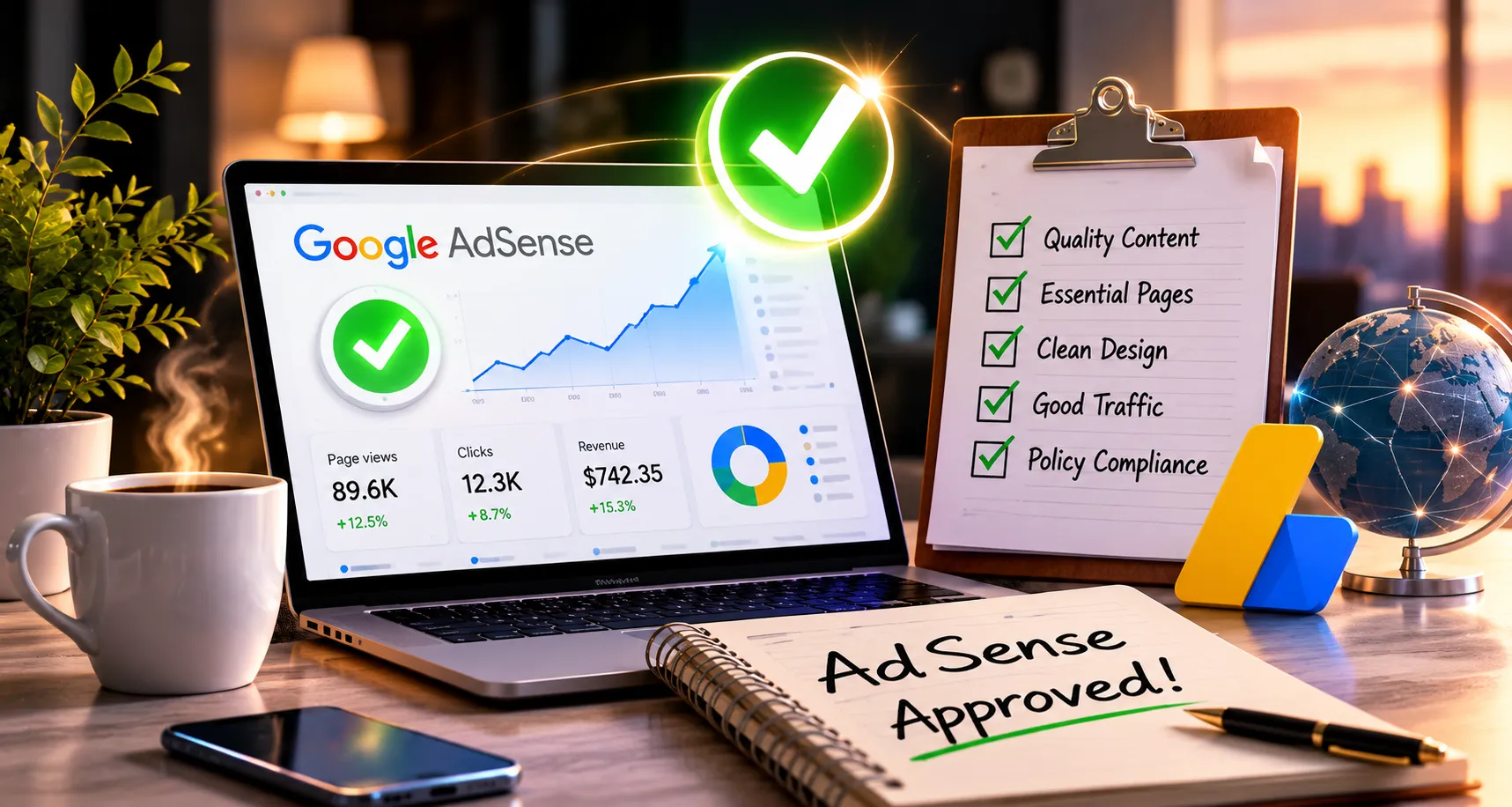
The BS Insider AdSense Approval Checklist
Run through every item below before you click submit. Every single one.
✅ Domain is at least 3 months old — 6 months is safer
✅ 20 to 30 high-quality articles published — 800 to 1,500 words each
✅ About Us page — real name, real credentials, real story
✅ Contact Us page — working email or contact form
✅ Privacy Policy page — covers cookies and Google Analytics
✅ Terms of Service page — covers content use and disclaimers
✅ Site runs on HTTPS — SSL certificate active
✅ Mobile responsive design — looks correct on phones
✅ PageSpeed score 70+ on mobile
✅ XML sitemap submitted to Google Search Console
✅ No broken links anywhere on the site
✅ No other ad networks active during review
✅ All images are copyright-free or original
✅ No thin, duplicate, or automatically generated low-value pages
✅ Some organic traffic from Google search
✅ Clean, professional navigation — essential pages findable in seconds
The Final Word
AdSense approval in 2026 is not difficult. But it is strict about one thing above all else: genuineness.
A genuine site built by a real person who actually knows their subject, publishing original content that actually helps readers, with the basic technical and legal requirements in place — that site gets approved. Almost every time.
The sites that get rejected are the ones that cut corners on content quality, apply too early, or miss the essential pages that Google specifically looks for. None of those problems are hard to fix. They just require honest self-assessment before you hit submit.
Build the site you would actually want to read. Make sure the legal pages are in place. Make sure the technical basics are clean. Give the domain some age.
Then apply with confidence.
Bilal Salfi | BS Insider