How to Build a Smart Home Under $200 in 2026 : The Beginner's Real Guide
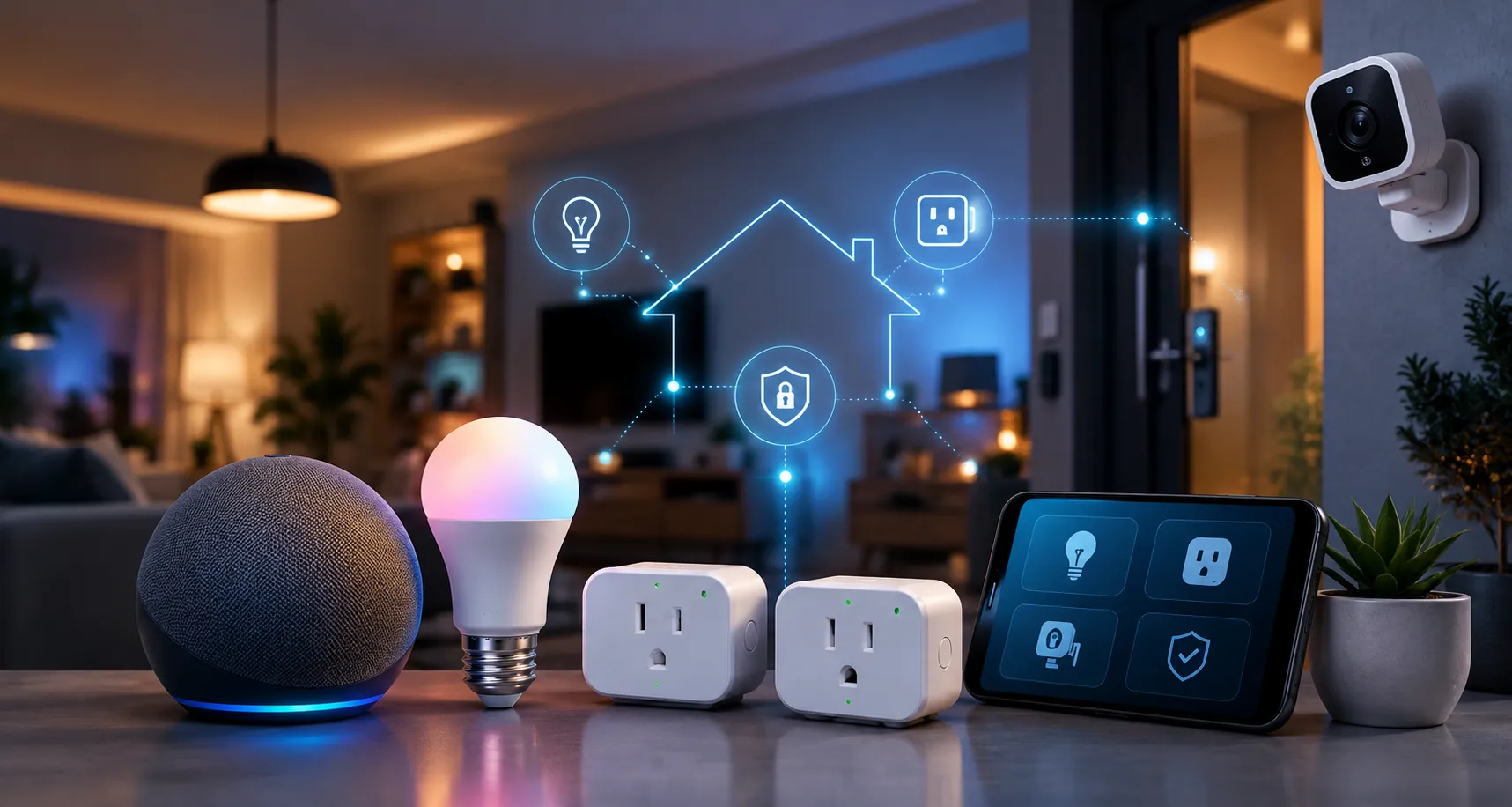
You Don't Need $2,000 to Start
Every smart home article you find online shows you a house with automated blinds, a $400 thermostat, a $300 video doorbell, and a lighting system that costs more than your monthly rent.
Then it says "smart homes are more affordable than ever."
I find that deeply dishonest. So let me write the article those people should have written.
You can build a genuinely useful, genuinely smart home for under $200 in 2026. Not a toy setup. Not two smart bulbs that you control from your phone once and never touch again. A real foundation that automates your lighting, gives you voice control, secures your front door digitally, and saves you money on electricity — all for less than the price of a mid-range smartphone.
This is exactly how to do it.
Before You Buy Anything, Understand This One Thing
The single biggest mistake new smart home buyers make is buying devices without thinking about ecosystem first.
In 2026 there are three major smart home ecosystems. Amazon Alexa. Google Home. Apple HomeKit. Every smart device you buy will work best inside one of these three families. Buy randomly across all three and you end up with three separate apps, three different voice commands, and devices that refuse to talk to each other properly.
Before spending a single rupee or dollar, answer this question: what phone and devices do you already own?
Android phone and Google account → Google Home ecosystem iPhone and Apple products → Apple HomeKit ecosystem Amazon Echo or Alexa fan → Amazon Alexa ecosystem
Pick one. Stay inside it. Every device recommendation below works across all three ecosystems — but knowing yours makes the setup experience dramatically smoother.
The other thing to know: Matter is the new universal standard in 2026 backed by Apple, Google, Amazon, and Samsung simultaneously. Devices with Matter support work across all three ecosystems without compromise. When you see Matter on a device label in 2026 — buy it with confidence. It is future-proof in a way no smart home device was two years ago.
Your $200 Budget , The Exact Breakdown
Here is the complete starter setup. Every device on this list is available right now, genuinely useful every single day, and adds up to under $200 total.
Step 1: The Brain - Smart Speaker ($35–$50)
Amazon Echo Dot 5th Gen - $35 or Google Nest Mini 2nd Gen - $30
Everything else in your smart home reports to this device. It is the hub. The brain. The thing you talk to when you want to turn the lights off without getting up from the couch.
The Amazon Echo Dot 5th Gen is the best value smart speaker available in 2026. Spherical design, improved audio hardware, built-in temperature sensor that can trigger Alexa routines automatically, and eero mesh WiFi technology built in. At $35 it is the entry point that hundreds of millions of people have used to start their smart home journey.
The Google Nest Mini is the better pick if you are already inside Google's ecosystem — Gmail, Google Calendar, Google Maps. It integrates with your Google account in ways that make daily routines genuinely intelligent. Ask it what your day looks like and it reads your calendar, tells you the weather, and reminds you about meetings.
Pick one. You only need one to start.
Budget remaining: $150–$165
Step 2: Smart Lighting - The Upgrade You Will Notice Every Single Day ($25–$40)
Wyze Bulbs Color 4-Pack — $30 or TP-Link Kasa Smart Bulbs 4-Pack — $28
Smart lighting is the smart home feature that changes daily life most visibly. And in 2026 it costs almost nothing to get started.
The Wyze Bulbs Color come in a four-pack for around $30 — roughly $7.50 per bulb. They cover the full colour spectrum, integrate with Alexa and Google Home, support scheduling based on sunrise and sunset, and can be triggered by motion sensors for hands-free automation. A four-pack covers your living room or bedroom completely.
The TP-Link Kasa Smart Bulbs are slightly cheaper, extremely reliable, and the 2026 version supports Matter for maximum compatibility. They do not offer full colour range — white tones only — but for most rooms that is all you need.
What changes when you have smart bulbs? More than you expect. You stop getting up to switch lights off before sleep. You set schedules so lights turn on automatically when you get home. You dim the bedroom at 10pm every night without touching a switch. Small automations that save time and energy every single day.
Budget remaining: $120–$137
Step 3: Smart Plugs - Turn Any Device Smart ($15–$25)
TP-Link Kasa Smart Plug Mini EP25 — $15 for 2-pack
This is the most underrated smart home device available. A smart plug takes any ordinary device — a fan, a lamp, a phone charger, a coffee maker — and makes it controllable by voice or schedule.
The TP-Link Kasa Smart Plug Mini in its 2026 version supports Matter and includes energy monitoring. That second feature is more useful than it sounds. Connect your television, your desktop computer, or your air conditioner through a smart plug and you can see exactly how much electricity each device is consuming. Most people discover at least one device left on standby that was quietly adding money to their electricity bill every month. The smart plug finds it. The schedule turns it off.
Two smart plugs for $15 is the definition of budget smart home value. Buy two packs and you have four smart plugs for $30.
Budget remaining: $90–$122
Step 4: Smart Security - See Who Is at Your Door ($25–$60)
Wyze Cam v4 — $35 or TP-Link Tapo C110 — $25
A smart security camera under $35 in 2026 sounds like it should be terrible. It is not.
The Wyze Cam v4 delivers 2K resolution video, colour night vision, motion detection with AI person recognition, two-way audio, and free cloud storage for 14 days of footage. At $35 it is the most complete security camera available at any price close to it. Place it facing your front door, your main room, or wherever matters most. View the live feed from your phone from anywhere in the world.
The TP-Link Tapo C110 at $25 is the most budget-friendly option that still delivers reliable 3MP video quality, night vision, and motion alerts. For a first camera that you want to try without significant investment, it is a solid starting point.
One camera at the front door changes how you feel about home security fundamentally. Delivery alerts. Visitor notifications. The ability to check your home when you are away. All for $25 to $35.
Budget remaining: $55–$97
Step 5: Smart Thermostat - Save Money Every Month ($50–$80)
Amazon Smart Thermostat — $60 or Google Nest Thermostat — $80
This is the optional device on this list — optional only because not every home has a compatible HVAC system. If yours does, this is the single device that pays for itself fastest.
The Amazon Smart Thermostat at under $80 was built in collaboration with Honeywell Home — one of the most trusted names in climate control. It learns your schedule, adjusts temperature automatically based on when you are home and away, and has consistently shown real energy cost reductions for users who install it. The energy savings over a year often exceed the purchase price.
The Google Nest Thermostat at $80 adds a colour display and deeper Google Home integration. If you are in the Google ecosystem and spend more time at home on irregular schedules, the Nest's learning algorithm adapts faster to unpredictable patterns.
Important: Before buying any smart thermostat check compatibility with your specific HVAC system at the manufacturer's website. Not all systems are compatible and this is worth verifying before purchase.
Your Complete $200 Smart Home - The Full Picture
Device | Price | What It Does |
|---|---|---|
Amazon Echo Dot 5th Gen | $35 | Voice control brain for everything |
Wyze Color Bulbs 4-Pack | $30 | Smart lighting for one full room |
TP-Link Kasa Smart Plugs x2 | $15 | Make any device smart + energy monitoring |
Wyze Cam v4 | $35 | 2K security camera, free cloud storage |
Amazon Smart Thermostat | $60 | Energy saving climate control |
Total | $175 | Complete starter smart home |
Twenty-five dollars under budget. Use it for an extra smart plug or a second bulb pack for another room.
The Three Automations You Should Set Up First
Buying the devices is only half the job. Here are the three automations that make a smart home actually feel smart from day one.
Automation 1: Good Morning Routine Set your smart bulbs to turn on gradually at your wake-up time — starting at 20 percent brightness and reaching full brightness over 10 minutes. Your body wakes up more naturally. Your alarm feels less violent. Takes two minutes to set up in the Alexa or Google Home app.
Automation 2: Leave Home Routine Create a single voice command or phone shortcut that turns off all lights, switches off all smart plugs, and sets your thermostat to energy-saving mode simultaneously. "Alexa, I'm leaving" handles everything at once. Never wonder again whether you left something on.
Automation 3: Motion-Based Lighting If your smart bulbs support motion sensor pairing — or you add a $10 motion sensor later — set lights in the hallway or bathroom to turn on automatically when motion is detected at night. No more fumbling for switches at 2am.
The Honest Limitations
A $200 smart home is a foundation. Not a finished house.
You will not have automated door locks at this budget. You will not have smart blinds or a complete multi-room audio system. The security camera at $35 is impressive but a $200 camera is more impressive.
The path forward after this setup is gradual. Add one device every month or two. A smart lock when budget allows — the Yale Assure Lock 2 is excellent. A second camera. More bulbs for additional rooms. A smart smoke detector.
The $200 setup gives you the ecosystem, the habit, and the understanding of how smart home automation actually fits into your life. That knowledge is worth more than any individual device.
Conclusions
Smart homes stopped being a luxury the moment Wyze started selling 2K security cameras for $35 and four smart bulbs for $30.
In 2026 the barrier to entry is not money. It is knowing where to start. Start with a voice assistant. Add smart lights. Add two smart plugs. Add one camera. Set up three automations that actually help you every day.
You will spend $175. You will save money on electricity. You will stop getting up to turn lights off. You will know who is at your door before you open it.
That is not a luxury anymore. That is just a smarter way to live.
Bilal Salfi | BS Insider