Google Pixel 9a in 2026 — The Phone That Makes $1,000 Flagships Look Embarrassed
Nobody Saw This Phone Coming
Let me paint you a picture.
It is 2026. The smartphone market is drowning in $1,000 phones, $1,200 foldables, and ultra-premium flagships that cost more than some people's monthly salary. Everyone is screaming about specs. Bigger numbers. Thicker camera bumps. More megapixels than your eyes can actually perceive.
And then Google quietly walks in with a $499 phone that outperforms machines costing twice its price in three critical areas — camera intelligence, battery life, and software longevity.
That phone is the Google Pixel 9a.
I have gone through every serious review, every benchmark, every real-world test available on this device. And I am going to give you the most honest, complete picture of whether this phone deserves a place in your pocket in 2026.
Spoiler: it might be the smartest phone purchase you make this year.
First, Let's Talk About What Google Did Differently
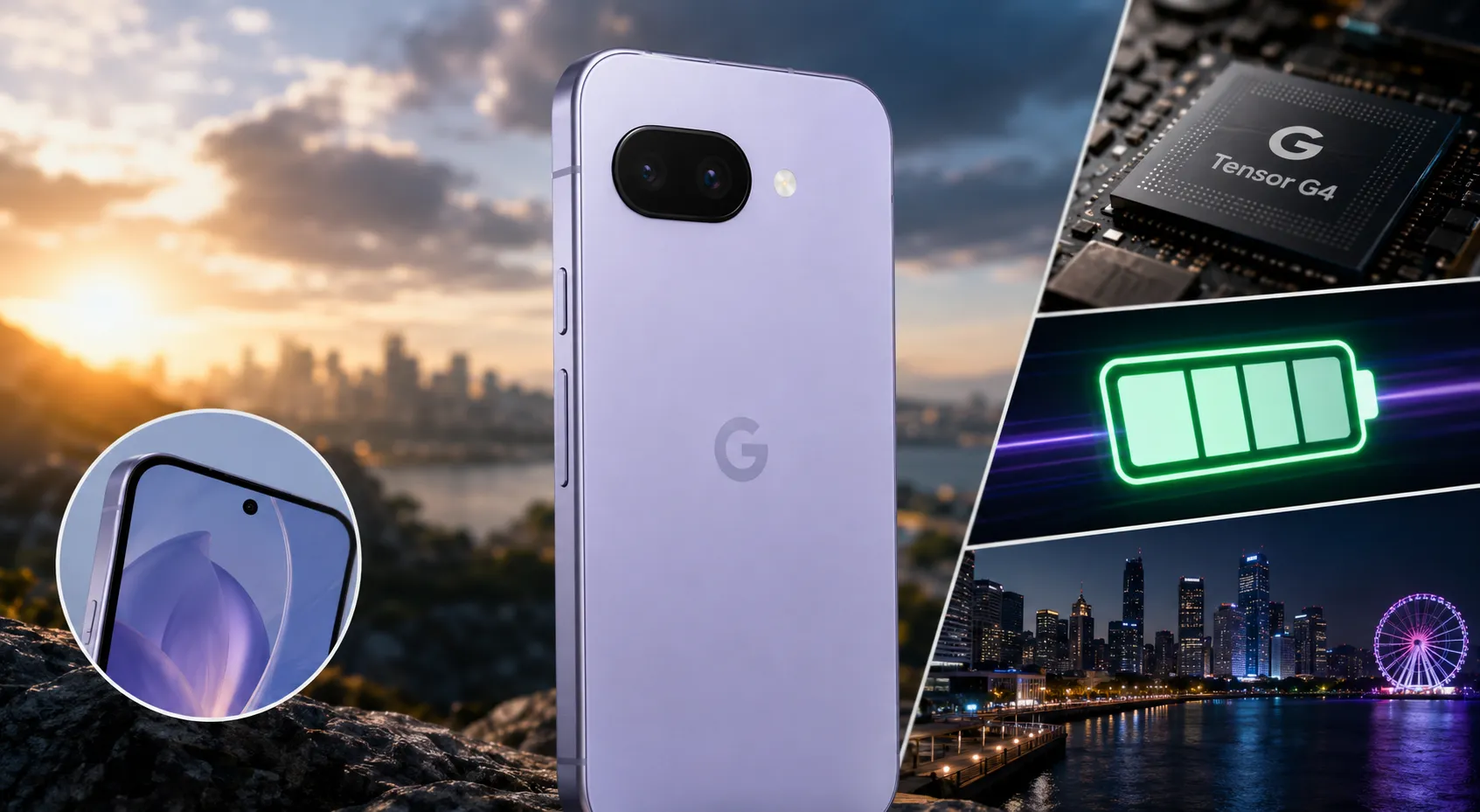
The Pixel 9a is not a flagship. Google never pretended it was. But here is what makes it genuinely special — Google took the same Tensor G4 chip from the full Pixel 9 flagship, dropped it into a $499 body, added the biggest battery ever put into any Pixel phone, and kept nearly all the AI software features that make Pixels worth buying in the first place.
That is not a budget strategy. That is a statement.
And in 2026, with the phone now available for as low as $399 on Amazon — a full year after its April 2025 launch — that statement gets even louder.
Design — The Camera Bar Is Gone. Get Over It.
The most controversial decision Google made with the Pixel 9a is right there on the back of the phone.
The iconic camera bar — that horizontal visor strip that made every Pixel phone instantly recognisable for years — is gone. In its place is a standard circular dual-lens array that sits in a small bubble on the rear. It looks, honestly, like a thousand other Android phones.
Some people hate this. And I understand why. The camera bar was identity. It was design language. When you saw it, you knew it was a Pixel.
But here is the practical upside nobody talks about: the phone now lies completely flat on a table without rocking. That sounds small until you have used a camera bar phone for two years and spent every day picking up a slightly tilted device.
The rest of the design is solid. Aluminium frame, plastic back, Gorilla Glass 3 on the front. IP68 dust and water resistance — meaning you can dunk this phone in 1.5 metres of water for 30 minutes and walk away fine. At $499, IP68 is not standard. It is a genuine differentiator.
Available in Obsidian, Porcelain, and the beautiful lavender Iris colorway. The phone is 186 grams, 8.9mm thick. Not the slimmest device on the market, and the bezels are noticeably chunky — a clear sign of where corners were cut to hit the price point.
It is not a beautiful phone. But it is a tough, purposeful one.
Display — Brighter Than Anything at This Price Has Any Right to Be
The Pixel 9a has a 6.3-inch P-OLED display running at 120Hz with a peak brightness of 2,700 nits.
Read that again. 2,700 nits peak brightness on a $499 phone.
Most phones at this price struggle to hit 1,000 nits. The Pixel 9a matches or exceeds displays found on $900 competitors. In direct Pakistani summer sunlight — or Australian summers, or anywhere the sun does not apologise for existing — this screen remains clearly visible. That is not a small thing for people who use their phones outside.
The 1080x2424 resolution at 422 pixels per inch is sharp and detailed. Colours are accurate and natural — Google calibrates its displays for real-world accuracy rather than oversaturated punch. Always-On Display is included, showing the time and notifications without waking the screen fully.
HDR support means streaming Netflix or YouTube in proper HDR quality. The viewing angles are excellent. Dark mode on OLED looks genuinely stunning because the pixels turn completely off for true blacks.
The one limitation: it is Full HD+, not Quad HD. For most people using a phone at arm's length, this is completely unnoticeable. Only display enthusiasts will care.
Bottom line on display: At this price, there is nothing better on the Android market. Nothing.
Performance — The Tensor G4 Chip Deserves More Credit Than It Gets
The Google Tensor G4 chip inside the Pixel 9a is the same processor found in the Pixel 9 flagship. Not a watered-down version. Not a binned chip. The same one.
In Geekbench scores, the Pixel 9a clocks 1,678 single-core and 4,216 multi-core — respectable numbers that comfortably handle everything a normal person does with a smartphone. Gaming on Call of Duty Mobile, Asphalt Legends, and similar titles runs without lag or stutter. Multitasking across multiple apps, streaming, browsing with 15 tabs open — all handled smoothly with the 8GB of RAM.
The Tensor G4 is not designed to win benchmark wars. It is designed to run Google's AI models efficiently and locally. That focus matters enormously for the features we will talk about in the next section.
What about long-term performance? This is where the Pixel 9a pulls ahead of almost every competitor at this price: Google has committed to 7 years of OS and security updates. The phone launched on Android 15. By the time Google stops supporting it in April 2032, it will be running Android 22.
Seven years. At $499. Samsung's A-series offers 5-6 years. Most Motorola and OnePlus phones in this range give you 3-4 years. The Pixel 9a at its price is in a completely different league for software longevity.
The Camera — Google's Real Magic Trick
Here is where I need to be completely honest with you, because the camera story on the Pixel 9a is more complicated than the specs sheet suggests.
On paper, it looks like a downgrade. The main sensor is 48MP at f/1.7. The ultrawide is 13MP. There is no telephoto lens. Compare that to the Pixel 8a's 64MP main sensor and it looks like Google went backwards.
But megapixels are not the whole story. The f/1.7 aperture is actually wider than the 8a's f/1.89, meaning more light enters the sensor on every single shot. More light is more detail. More light is better night photography. The aperture upgrade quietly compensates for the megapixel reduction in ways that actually matter in real life.
DXOMARK, the most respected camera testing lab in the industry, found that the Pixel 9a delivers the same excellent exposure and colour accuracy as the more expensive Pixel 9, with vibrant colours, wide dynamic range, and reliable autofocus. Where it falls behind is in extreme low-light detail — slight noise in very dark conditions, and some inconsistency in consecutive shots. No dedicated telephoto also means digital zoom quality drops off past 2x.
But here is what no spec number captures: Google's computational photography is genuinely in a different category from every other phone at this price.
Magic Eraser removes unwanted objects from photos with a single tap. Tourist in the background of your perfect shot? Gone in two seconds.
Best Take uses AI to scan a series of photos and select the best facial expression from each person individually, then composite them into one perfect group photo. Every person smiling. No more "almost perfect" group shots.
Real Tone is Google's technology to accurately render all skin tones in all lighting conditions. For people of colour who have spent years being poorly photographed by camera systems built primarily around lighter skin tones, this is not a small feature. It is a meaningful one.
Night Sight handles low-light photography better than almost any camera system at this price — using AI processing rather than simply increasing ISO.
Macro Focus and Astrophotography — previously reserved for Pixel Pro models — are both available on the 9a for the first time in the A-series.
Add Me lets you add yourself into a group photo you were not present for because you were busy taking the picture. It is the end of the photographer being absent from their own memories.
Every reviewer who spent real time with this camera said the same thing: shots are consistently good, colours are true to life, and the AI features work better in practice than they sound in a press release.
For a $499 phone, this camera system is extraordinary. Not because of the hardware. Because of the intelligence behind it.
Battery — The Biggest Surprise of the Entire Phone
The Google Pixel 9a has a 5,100 mAh battery.
That is the largest battery ever put into any Pixel phone. Ever.
Multiple reviewers report the phone easily lasting two full days on a single charge with moderate use. Heavy users — streaming, gaming, navigation — comfortably get through a full 24 hours without anxiety. The combination of an efficient Tensor G4 chip and that enormous battery pack creates something rare in smartphones: genuine all-day confidence.
No more watching the battery percentage drop past noon and rationing your usage. No more carrying a power bank as standard equipment. The Pixel 9a just lasts.
The honest catch: charging speed is 23W wired. That is slow by 2026 standards, where competitors offer 45W and 65W fast charging. Wireless charging is supported at 7.5W — appreciated at this price point, but slow. A depleted battery will take over an hour to fully charge.
But here is the counter-argument: if your battery lasts two days, how often are you charging from zero? The slow charging is a real limitation but a practical non-issue for most people.
AI Features — Google's Biggest Advantage Over Everyone
If there is one area where the Pixel 9a creates clear distance between itself and every other phone under $500, it is AI.
Gemini is built into the Pixel 9a as the default AI assistant, replacing Google Assistant. Rather than the rigid command-response pattern of old assistants, Gemini understands natural, conversational language. Ask it to summarise a long article, help you write a reply to a difficult email, or explain something complex — it handles all of it with real intelligence.
Circle to Search lets you draw a circle around anything on your screen — a product, a landmark, a piece of text — and instantly search for it without leaving the app you are in. It sounds simple. In practice it changes how you use your phone.
Call Assist screens spam calls automatically, suggests smart replies, and can answer calls on your behalf while transcribing the conversation in real time. Nobody else in the $499 price range offers this level of call intelligence.
Clear Calling uses AI to filter background noise from phone calls — both yours and the caller's — for crystal clear audio in any environment.
Live Translate provides real-time voice and text translation across languages during phone calls. For international users, travellers, or anyone communicating across language barriers, this is not a nice-to-have. It is a life-changer.
What the 9a does NOT get: Pixel Screenshots (the AI feature that understands and indexes your screenshots) and a full year of Gemini Advanced. Those stay with the Pro models. A fair compromise for the price.
The One Thing Google Got Wrong...!
I will always give you the honest picture. And the Pixel 9a has one clear failure that needs to be said plainly.
The bezels are thick. Noticeably, almost embarrassingly thick for a 2026 phone. The chunky black borders around the display make the Pixel 9a look like a phone from 2022 from the front. Every reviewer noticed it. Nobody could defend it.
At $499 you make compromises. The bezels are Google's most visible compromise, and it shows.
Should You Buy the Pixel 9a in 2026...?
Here is the simplest, most honest answer I can give:
If you are currently paying $400 to $449 for this phone on Amazon right now, you are getting a deal that should not exist.
You are getting the same chip as a $799 flagship. The largest battery in Pixel history. A camera system with AI features that $1,000 phones do not have. Seven years of guaranteed updates. IP68 water resistance. A display that peaks at 2,700 nits of brightness.
The compromises — thick bezels, slow charging, no telephoto lens, generic design — are all real. But every single one of them becomes negotiable the moment you look at the price.
Buy the Pixel 9a if:
You want the best camera AI available under $500
Battery life matters more to you than charging speed
You want a phone that will feel fresh and updated in 2030
You are an Android user who wants clean, fast, bloatware-free software
You travel or communicate across languages regularly
Skip the Pixel 9a if:
You care deeply about phone design and thin bezels
Fast charging is non-negotiable in your daily life
You play console-level mobile games and need maximum GPU power
You are already in the Apple ecosystem and switching feels unreasonable
BS Insider Final Scorecard
Category | Score | Verdict |
|---|---|---|
Design & Build | 7.5/10 | Chunky bezels hurt, IP68 saves it |
Display | 9/10 | 2,700 nits at $499 is extraordinary |
Performance | 8.5/10 | Tensor G4, 7-year updates, flagship chip |
Camera | 8.5/10 | AI magic compensates for hardware limits |
Battery | 9.5/10 | Best battery in Pixel history. Period. |
AI & Software | 9/10 | Nothing at this price comes close |
Value | 10/10 | At $399-449 in 2026, it is a steal |
OVERALL | 8.8/10 | The Sleeper Hit of 2026 |
My Final Words
The Google Pixel 9a is not the most exciting phone you will see in 2026. It does not have the most dramatic camera bump or the thinnest body or the fastest charging. It will not win any beauty contests.
But it will take stunning photos of your family. It will last two days on a single charge. It will stay updated and fast until 2032. It will screen your spam calls, translate your conversations, and quietly make your daily life better in dozens of small ways that add up to something genuinely significant.
And in 2026, you can buy it for under $400.
That is not a budget phone. That is a smart phone — in every meaning of the word.
Danial Salfi | BS Insider