From Silent Frames to IMAX Giants: The Evolution of Cinema
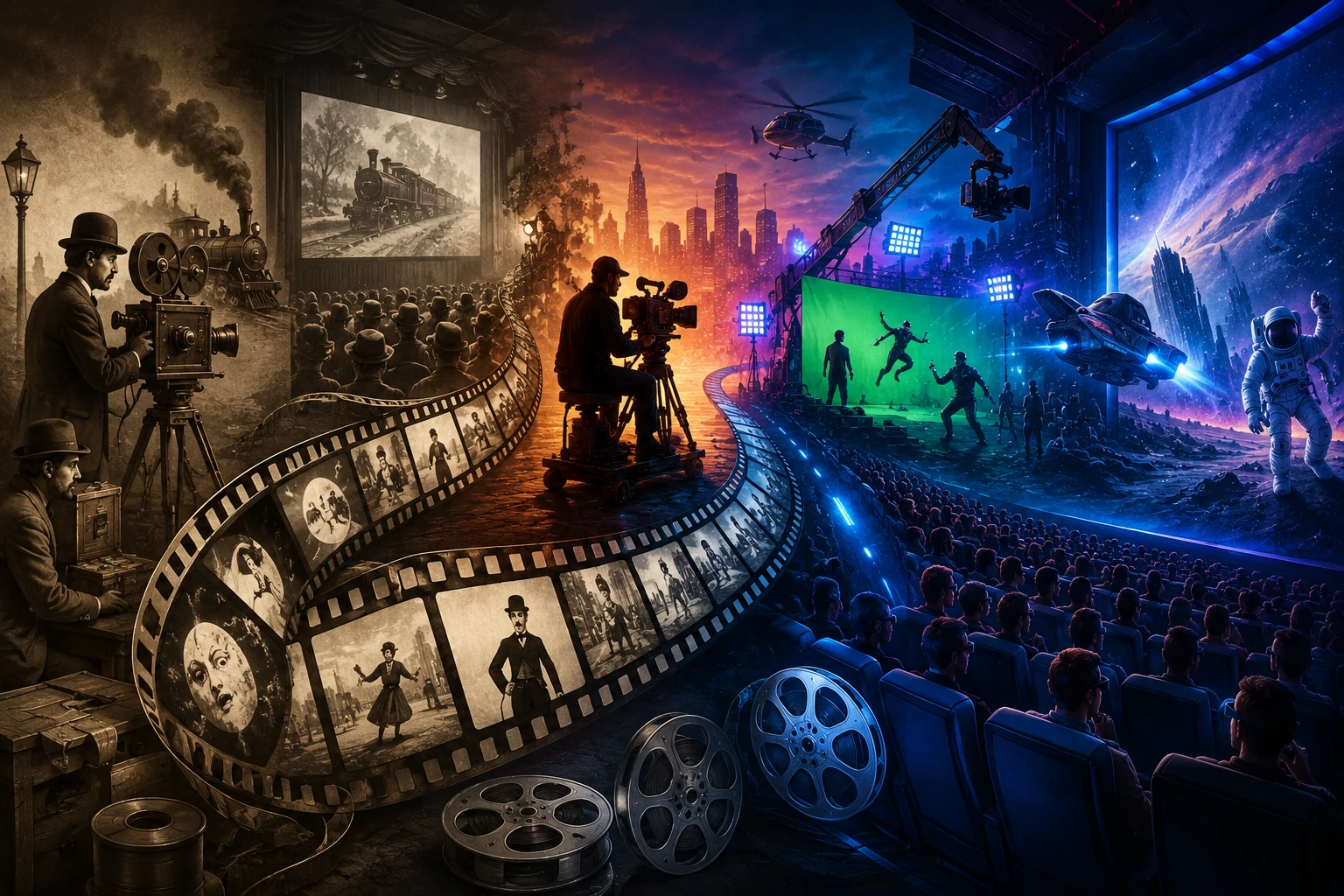
We all know, there was a time when watching moving images felt like witnessing magic.
No surround sound. No CGI. No billion-dollar superhero universes. Just a grainy black-and-white clip of factory workers leaving a building and people in the audience sat there stunned, unable to believe what they were seeing.
Today, cinema has become one of the most technologically advanced industries on Earth. Modern films are shot with cameras capable of capturing microscopic details, projected on giant IMAX screens taller than buildings, mixed with immersive Dolby Atmos sound, and enhanced using artificial intelligence, virtual production, and CGI powerful enough to create entire universes from nothing.
But none of this happened overnight.
Cinema evolved through more than 130 years of experimentation, failure, obsession, engineering breakthroughs, artistic revolutions, and the relentless work of thousands of visionaries who refused to accept limitations.
This Story is about of how movies evolved from silent moving photographs into the most powerful storytelling medium humanity has ever created.
The Time Before Movies Even Existed
Long before cinema, humans were already obsessed with motion.
Ancient civilizations painted animals with multiple legs on cave walls to simulate movement. In the 1800s, inventors began experimenting with optical illusions like the zoetrope and phenakistoscope, spinning devices that tricked the human eye into seeing motion.
The scientific principle behind all of this was called “persistence of vision,” the idea that the human brain can briefly retain an image after it disappears. (Encyclopedia Britannica)
This tiny psychological illusion eventually became the foundation of the entire film industry.
Then came photography.
Once humans learned how to freeze a moment in time, the next obsession became obvious:
“What if we could make the image move?”
The Men Who Accidentally Created Cinema
The birth of movies wasn’t the work of one person.
It was a chain reaction of inventors building on each other’s ideas.
In the late 1800s, innovators like Eadweard Muybridge experimented with sequential photography. His famous galloping horse experiment proved that rapid still images could simulate motion.
But the true industrial leap came from inventor Thomas Edison and his assistant W.K.L. Dickson.
Edison wanted to create a machine that could do for the eyes what the phonograph did for the ears. Together, they developed the Kinetograph camera and the Kinetoscope viewer. (Encyclopedia Britannica)
The problem?
Only one person at a time could watch the footage through a peephole machine.
Cinema still wasn’t a shared experience.
That changed forever in France.
The Lumière Brothers Changed Everything
In 1895, two French brothers, Auguste Lumière and Louis Lumière, invented the Cinématographe, a lightweight machine capable of recording, developing, and projecting motion pictures onto a screen for a crowd. (National Geographic)
And suddenly, cinema was born.
On December 28, 1895, they held what is widely considered the first commercial public movie screening in Paris. (National Geographic)
One of the films shown was:
“Workers Leaving the Lumière Factory.”
Just ordinary people walking out of work.
No plot.
No dialogue.
No editing.
No soundtrack.
Yet audiences were mesmerized.
For the first time in human history, reality itself had been captured and replayed.
People weren’t just watching images anymore.
They were watching time.
The Famous Train Scene That Terrified Audiences
One of the Lumière brothers’ most legendary films was “Arrival of a Train at La Ciotat Station.”
According to popular stories, audiences panicked and moved away from the screen because they believed the train was coming directly toward them.
Whether exaggerated or not, the reaction revealed something important:
Cinema had emotional power.
People weren’t merely observing images.
They were feeling them.
That realization changed entertainment forever.
Georges Méliès, Was the First True Movie Magician
While the Lumière brothers saw cinema mainly as a technological novelty, one man saw something much bigger.
Georges Méliès.
A magician by profession, Méliès realized films could create fantasy, illusion, storytelling, and impossible worlds. (Encyclopedia Britannica)
He pioneered:
Special effects
Stop-motion tricks
Multiple exposures
Visual storytelling
Fantasy filmmaking
His 1902 film, A Trip to the Moon, became one of the most influential films ever made.
That iconic image of a rocket hitting the moon’s eye is still one of cinema’s most recognizable visuals more than a century later.
Without Méliès, modern CGI-heavy cinema probably wouldn’t exist.
He proved movies didn’t have to copy reality.
They could create entirely new realities.
The Silent Era, When Acting Became an Art Form
As cinema evolved, filmmakers learned how to edit scenes together, use camera angles, and tell emotional stories visually.
This led to the silent film era.
Actors had no spoken dialogue, so emotion had to be expressed entirely through body language, facial expressions, lighting, and movement.
And this period created the world’s first movie superstars.
The most iconic among them was Charlie Chaplin.
Chaplin transformed silent cinema into emotional art. His films balanced comedy, poverty, loneliness, politics, and humanity in ways that still resonate today.
Cinema was no longer a scientific invention.
It had become culture.
The Revolution of Sound
For decades, movies were silent because recording synchronized sound was technically difficult.
Then came 1927.
The Jazz Singer introduced synchronized dialogue to mainstream audiences.
And Hollywood changed overnight.
Silent film stars disappeared.
Studios adapted.
Audiences demanded talking pictures.
The industry exploded.
Now movies could combine:
Visual storytelling
Music
Voice
Emotion
Atmosphere
Cinema became more immersive than ever before.
The Colors Changed the Emotional Language of Film
Early films were black and white, though some experimented with hand-painted frames.
But eventually, technologies like Technicolor transformed cinema forever.
Movies like The Wizard of Oz shocked audiences with vibrant worlds unlike anything seen before.
Color wasn’t just visual enhancement.
It became emotional language.
Warm tones created comfort.
Blue created sadness.
Red created tension.
Filmmakers began painting emotion directly onto the screen.
Hollywood Became a Global Machine
By the mid-20th century, Hollywood evolved into a massive industrial ecosystem.
Studios like:
turned filmmaking into a highly organized production pipeline.
Massive sets were built.
Orchestras recorded scores.
Writers crafted screenplays.
Engineers invented better cameras.
Cinema became one of the largest industries in the world.
The Birth of Blockbusters
Then came directors who completely changed audience expectations.
Filmmakers like:
Steven Spielberg
George Lucas
Stanley Kubrick
Martin Scorsese
pushed cinema into a new era.
Films like:
Jaws
Star Wars
2001: A Space Odyssey
proved movies could become global events.
Audiences didn’t just “watch” films anymore.
They lined up for them.
Discussed them.
Collected merchandise.
Built fandoms around them.
Cinema had become an emotional ecosystem.
When CGI Changed Reality Itself
One of the biggest technological explosions in film history came through computer generated imagery.
Before CGI, filmmakers relied on:
Miniatures
Practical effects
Makeup
Mechanical props
Then digital graphics evolved.
Movies like:
Terminator 2: Judgment Day
Jurassic Park
The Matrix
changed audience expectations forever.
Dinosaurs looked alive.
Machines transformed realistically.
Physics itself could be manipulated on screen.
Cinema was no longer limited by physical reality.
Anything imaginable became filmable.
IMAX: When Cinema Became an Experience
Then came immersive formats.
Modern cinema evolved beyond storytelling into sensory experience.
IMAX transformed movie watching using:
Massive high-resolution screens
Specialized cameras
Enhanced sound systems
Greater image clarity
Directors like Christopher Nolan became obsessed with IMAX filmmaking.
Films such as:
Interstellar
Dunkirk
Oppenheimer
pushed cinematic immersion to extreme levels.
Audiences weren’t just watching a movie anymore.
They were inside it.
The Streaming Era Changed Everything Again
The internet disrupted cinema in ways nobody expected.
Streaming platforms like:
changed audience behavior completely.
People no longer waited for theaters.
Cinema entered homes, phones, tablets, and laptops.
The industry had to evolve again.
Some feared theaters would die.
Instead, cinema split into two worlds:
Home convenience
Premium theatrical spectacle
That’s why modern theaters now focus heavily on IMAX, Dolby Cinema, 4DX, laser projection, and luxury seating.
Theaters realized they had to offer something impossible to replicate at home.
An experience.
Artificial Intelligence and Virtual Production
Now cinema is entering another revolution.
AI-assisted editing, de-aging technology, virtual production stages, motion capture, and real-time rendering engines are reshaping filmmaking.
Shows like The Mandalorian popularized LED virtual production walls powered by gaming engines.
Instead of filming in deserts or alien planets, filmmakers can now create entire worlds digitally in real time.
The line between filmmaking and software engineering is disappearing.
Cinema is becoming computational.
The Most Important Truth About Cinema
Technology evolved constantly.
But one thing never changed.
Human emotion.
From silent factory workers in 1895 to giant IMAX spectacles in 2026, the goal of cinema has remained the same:
To make humans feel something.
Fear.
Wonder.
Love.
Sadness.
Hope.
That is why movies survived every technological shift.
Black and white to color.
Silent to sound.
Film to digital.
Theaters to streaming.
Practical effects to CGI.
Cinema keeps evolving because storytelling is deeply human.
And humans never stop searching for stories.
My Final Thoughts
It’s honestly unbelievable to think about how far cinema has come.
The entire modern film industry, worth hundreds of billions today, began with tiny experimental clips lasting less than a minute.
Nobody back then could have imagined:
IMAX cameras in space
Fully digital actors
AI-assisted filmmaking
Motion-captured worlds
Real-time CGI rendering
Global streaming platforms
Yet every modern breakthrough traces back to a handful of inventors experimenting with moving photographs in the 1890s.
Cinema didn’t evolve because technology existed.
It evolved because humans refused to stop imagining.
And honestly, the next chapter may be even crazier than the last.