Beyond the Code - Why 2026 is the Year AI Finally "Read" the Human Genome as Natural Language
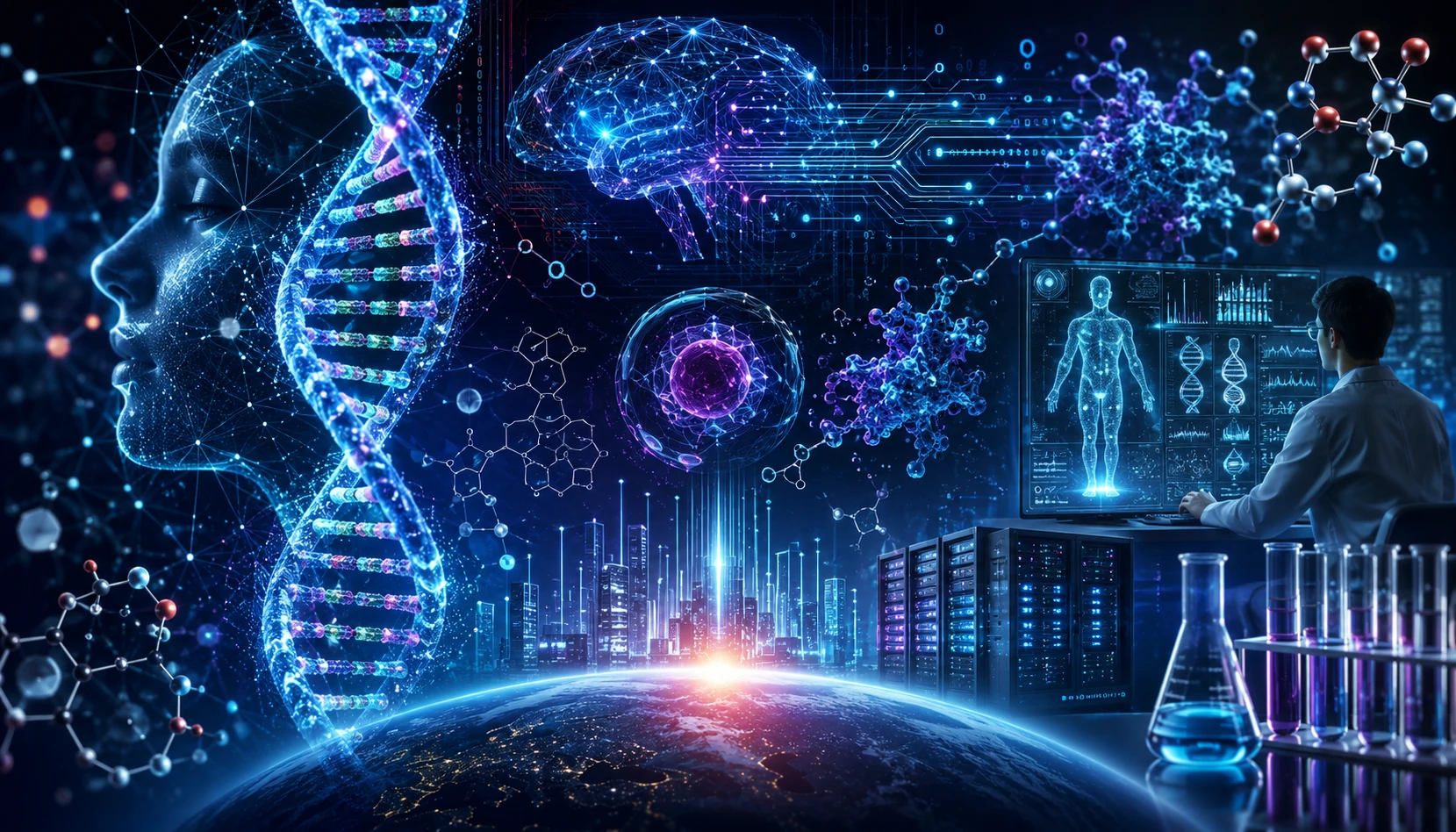
As a student of physics, I’ve always viewed the universe through the lens of entropy and information. We spend our years studying how particles interact, but the most complex "system" in the known universe isn't a star or a galaxy, it’s the human genome. For decades, we treated DNA as a static library. But in May 2026, the scientific community has reached a tipping point: we are no longer just "sequencing" the genome; we are finally talking to it.
From ACGT to "Biological Grammar"
In my graduation research, we often discuss the Transformer architecture, the same tech behind ChatGPT. In 2026, the breakthrough isn't just "faster sequencing." It’s the realization that DNA is not just a code; it’s a language with its own grammar, syntax and long-range dependencies.
Genome Language Models (gLMs): Just as LLMs predict the next word in a sentence, new gLMs predict the functional impact of a genetic variant.
Intricate Grammar: These models can now identify "distant regulatory interactions" parts of your DNA that affect each other even if they are millions of base pairs apart.
The "Context" Win: Older models looked at small snippets of DNA. 2026 models use State Space Models and Hyena convolutions to look at the entire genomic context at once.
The Grand Unified Theory of Biology
In Physics, we search for the "Theory of Everything." In Biology, that theory is Multiomics. As of May 2026, AI researchers are no longer looking at just genes (Genomics).
We are now integrating:
Proteomics: The actual proteins your body builds.
Transcriptomics: How your genes are being "read" in real-time.
Metabolomics: The chemical fingerprints left behind by cellular processes.
AI acts as the integrator, finding hidden relationships between these layers that a human scientist could never spot. This "multi-scale" view is what allows us to predict a disease's progress years before a single symptom appears.
The Hardware Frontier: HPC and GPU-Native Science
I have to talk about the "engine" under the hood. Mapping the genome in natural language requires High-Performance Computing (HPC) that would have been unthinkable five years ago.
Foundation Models for Biology: We are seeing the rise of "Biological Foundation Models" trained on petabytes of multi-species data.
HPC Simulations: We aren't just reading data; we are running Virtual Cell simulations. We can "virtually" test how a new drug molecule will react with a specific person's unique genetic structure before it ever leaves the digital lab.
Why This Actually Matters for the USA and Global Markets?
The economic shift is massive. The AI in Genomics market is projected to skyrocket from $1.67 billion in 2025 to over $13 billion in the next decade.
Personalized Medicine: In the US, the goal is "Individualized Care", treatments tailored specifically to your unique genetic characteristic.
Rapid Drug Discovery: Companies like Insilico Medicine are now moving molecules to human trials in record time by using Generative Adversarial Networks (GANs) to "invent" new medicine.
A Science Researcher Perspective: The Entropy of Discovery
From a physics standpoint, what we are doing is reducing the uncertainty of life. We are taking the "noise" of biological data and turning it into a "signal" we can understand.
The future isn't just about AI doing our homework; it’s about AI helping us understand the very atoms that make us "us." We are moving from a world where we "hope" a treatment works to a world where we know it will, because we’ve already read the manual, the human genome.