AI Is Quietly Killing Search Engines
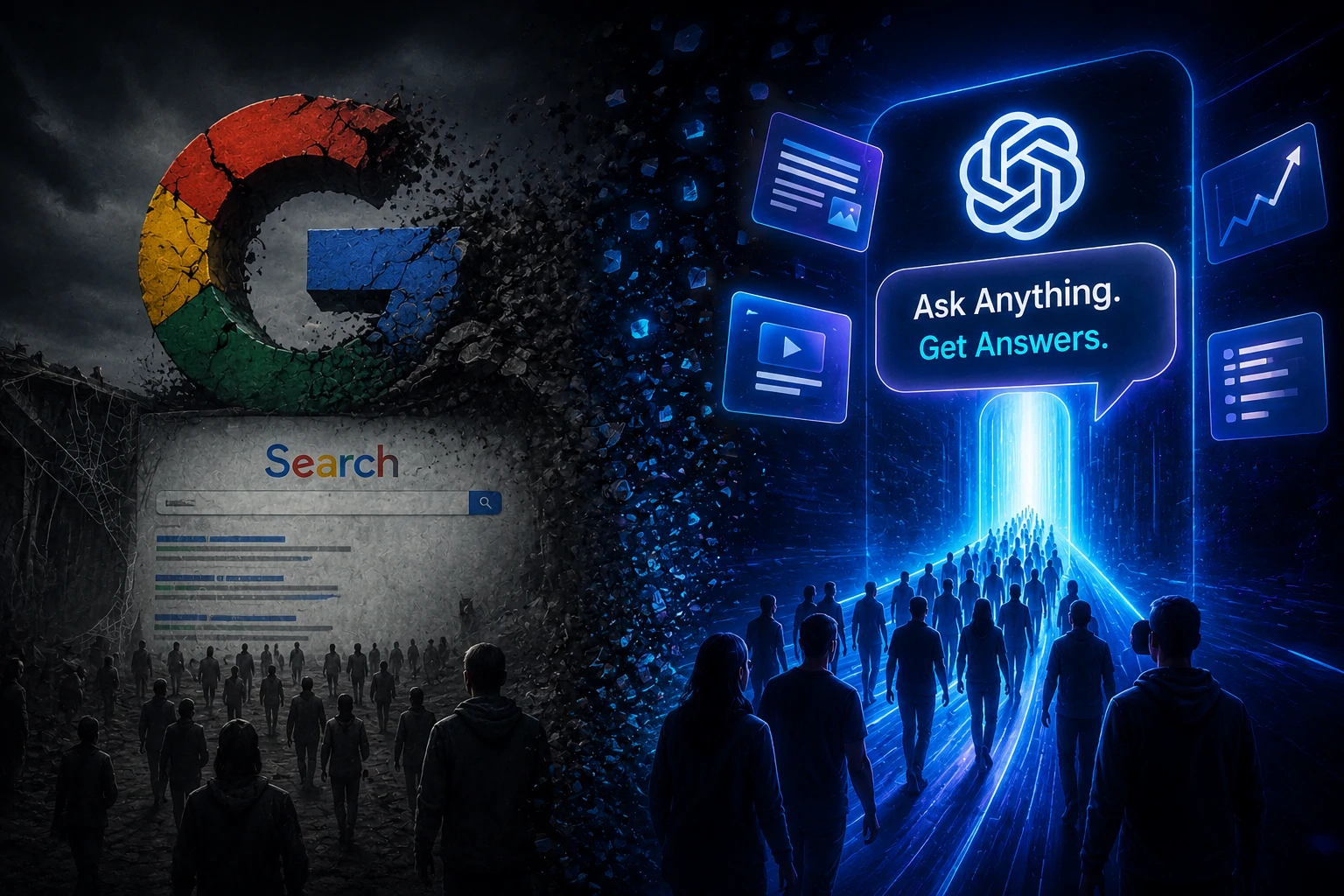
For nearly two decades, the internet worked in a very predictable way.
You opened Google.
Typed a few keywords.
Scrolled through blue links.
Opened 7 tabs.
Ignored 5 of them.
Read two articles.
Closed everything.
Repeated the process again tomorrow.
That behavior became so normal that people stopped questioning it.
Google wasn’t just a website anymore.
It became infrastructure.
A utility.
A reflex.
“Search it on Google” became part of human language itself.
But something strange has started happening over the past two years.
People are searching less.
Not because information disappeared.
Not because the internet became smaller.
But because millions of users are quietly skipping search engines entirely.
Instead of searching, they’re asking AI.
And that changes everything.
The Beginning of the Shift
At first, AI chatbots looked like novelty tools.
People asked silly questions.
Generated poems.
Created memes.
Tested weird prompts.
But then something important happened.
Users realized AI could do something traditional search engines never truly solved:
It could synthesize information instantly.
Instead of giving you:
10 blue links
SEO-optimized articles
ad-filled pages
cookie popups
sponsored content
AI simply gives you an answer.
And humans naturally prefer the easier path.
That’s the core threat.
Google’s Biggest Problem Was Created by Google Itself
Ironically, Google partially created the conditions for its own disruption.
Over the years, search results slowly became polluted.
People noticed:
too many ads
affiliate spam
SEO farms
recycled articles
low-quality clickbait
pages designed for algorithms instead of humans
Searching started feeling exhausting.
Sometimes finding a simple answer required opening multiple websites overloaded with ads, autoplay videos, newsletter popups, and endless filler paragraphs.
Users became tired.
AI arrived at the perfect moment.
When ChatGPT Changed User Psychology
The real disruption wasn’t technological.
It was behavioral.
ChatGPT trained people to interact with information conversationally.
Instead of typing:
“best budget laptop 2026 battery life”
people started typing:
“I’m a university student, I travel a lot, I need long battery life and light gaming performance under $800.”
That’s not search anymore.
That’s dialogue.
And once users experience conversational information retrieval, traditional keyword searching starts feeling primitive.
This is the same reason smartphones replaced feature phones.
Not because old phones stopped working.
But because the interaction model fundamentally improved.
The Numbers Are Starting to Look Serious
For years, Google’s dominance looked untouchable.
But cracks are finally appearing.
According to Gartner, traditional search engine volume is expected to drop 25% because users are shifting toward AI chatbots and virtual agents. (Gartner)
Multiple reports now suggest that around 37% of users already begin searches using AI tools instead of traditional search engines. (CODERCOPS)
That number would have sounded impossible just three years ago.
Meanwhile, ChatGPT’s growth has been explosive.
Research from Semrush analyzing 17 months of clickstream data found ChatGPT becoming a standard part of internet behavior, with outbound referral traffic growing over 200% in 2025 alone. (Semrush)
Another report claims ChatGPT now handles roughly 12% of Google’s search volume equivalent. (Android Headlines)
Twelve percent.
For perspective, most search engines in history failed to even dent Google by 1–2%.
The Era of “10 Blue Links” Is Dying...?
The biggest transformation is structural.
Traditional search engines were built around discovery.
AI systems are built around completion.
That difference matters.
Google’s model:
“Here are links. Go figure it out.”
AI’s model:
“Here’s your final answer.”
That completely changes user behavior.
Modern AI systems:
summarize
compare
explain
rewrite
personalize
contextualize
continue the conversation
Search engines mostly never evolved beyond indexing pages.
AI evolved into reasoning layers on top of information.
That’s why younger users especially are adapting quickly.
They don’t want to “search.”
They want resolution.
Google Already Knows This Threat Is Real
One of the biggest signs that this shift is serious:
Google itself is panicking internally.
That’s why:
AI Overviews
Gemini integration
conversational search
AI Mode
answer summaries
are now aggressively pushed into Google Search.
Google understands something terrifying:
If users stop visiting search pages entirely, Google’s entire business model weakens.
And this is not a small business.
Google Search generates tens of billions in revenue every quarter.
Search isn’t just a product for Google.
It is the foundation of the company.
The Silent Victims: Websites and Publishers
There’s another side to this story nobody talks about enough.
Websites are losing traffic.
Quietly.
Brutally.
AI-generated summaries often answer questions directly without sending users to original sources.
This creates what experts now call “zero-click behavior.”
Users get answers without visiting websites.
Several studies now suggest zero-click searches are exploding because of AI summaries and answer engines. (AddWeb Solution)
One academic study analyzing Google AI Overviews found traffic reductions of around 15% for affected Wikipedia pages. (arXiv)
Another research paper warned that AI search systems may reduce information diversity while concentrating attention toward fewer sources. (arXiv)
This is a massive internet-wide shift.
Because the open web survives on traffic.
Without traffic:
publishers lose ad revenue
blogs die
independent creators disappear
journalism weakens
AI companies still need human-created content to train and ground responses.
But if creators stop getting rewarded, the ecosystem becomes unstable.
The internet may slowly become an AI-generated mirror hall recycling its own outputs.
That possibility is deeply unsettling.
Ask Jeeves Accidentally Predicted the Future
One of the strangest moments in all of this happened recently.
Ask Jeeves — one of the earliest conversational search engines from the 1990s — officially shut down in 2026. (TechRadar)
And ironically, its original concept is now returning through AI chat interfaces.
Back in the 90s, Ask Jeeves allowed users to type natural questions instead of keywords.
At the time, the internet wasn’t ready for that idea.
Today, the entire tech industry is racing toward it.
History has a weird sense of humor.
But AI Has Serious Problems Too
AI search is not perfect.
Not even close.
It still:
hallucinates facts
invents sources
spreads misinformation
lacks transparency sometimes
overconfidently states wrong answers
And that creates another dangerous issue:
Humans trust conversational systems more emotionally than traditional search engines.
A list of links feels neutral.
An AI response feels authoritative.
That psychological difference matters enormously.
Several researchers are now warning that AI-generated search results may reduce exposure to diverse viewpoints and increase informational centralization. (arXiv)
So while AI search feels more convenient, it may also become more controlling over what humans see.
That tradeoff is only beginning to be understood.
This Isn’t the Death of Google - Yet
Despite the dramatic shift, Google is still gigantic.
Billions of searches still happen daily.
Many reports show traditional search remains dominant overall. (AddWeb Solution)
But dominance is no longer the same as invincibility.
That’s the key difference.
For the first time in decades, human information behavior is genuinely changing.
And once behavior changes, industries eventually follow.
The same thing happened to:
cable TV
newspapers
DVDs
malls
taxis
desktop PCs
People rarely notice revolutions while they’re happening.
Only afterward.
The Future of Search May Not Even Be “Search”
The next phase may become even more radical.
AI agents are evolving from answering questions to completing tasks.
Instead of:
“Here are flight options.”
Future AI systems may simply:
book flights
compare prices
summarize reviews
fill forms
handle reservations
negotiate subscriptions
The user may stop browsing entirely.
And if that happens, traditional search engines won’t just shrink.
The entire structure of the web economy could change.
My Final Thoughts
The scary part is that this transformation is happening quietly.
There was no dramatic announcement.
No sudden collapse.
No “Google killer” moment.
People are simply changing habits little by little.
One question at a time.
One AI prompt at a time.
That’s how technological shifts usually happen.
Silently first.
Then suddenly.
Search engines probably won’t disappear tomorrow.
But the era where humans manually searched through pages of blue links may eventually feel as outdated as renting DVDs or using paper maps.
And honestly?
We may already be living through the beginning of that transition.